Today’s businesses don’t run in one place anymore. Applications live across on-prem systems, SaaS platforms, and multiple clouds – and attackers know it. As environments scale, security visibility doesn’t always scale with them.
The result?
Security incidents are more frequent, more expensive, and harder to detect than ever before. Industry studies consistently show that the average cost of a data breach now runs into millions, while cloud misconfigurations and credential theft remain among the top attack vectors. Worse, many breaches go unnoticed for months – long enough to cause real business damage.
Do You Know? Servers are the primary targets of 90% of data breaches, and cloud-based web application servers are affected the most. – Source: SentinelOne
That’s why security can no longer be reactive.
SecOps (Security Operations) brings security and operations together into a continuous, always-on defense model. It gives organizations a dedicated function to monitor threats 24/7, respond to incidents in real time, and keep critical services running – even during active attacks. Instead of scrambling after something breaks, SecOps helps teams spot risks early and act before they escalate.
In this guide, we break down:
- SecOps meaning and why it matters for growing businesses
- Key SecOps roles and responsibilities
- How SecOps works in cloud and hybrid environments
- The core benefits and essential SecOps tool categories
- Practical SecOps best practices – woven with how Rapyder approaches security operations at scale
If your business is scaling on the cloud, this isn’t about tightening screws – it’s about staying resilient while you grow.
What Is SecOps?
SecOps Meaning:
In simple terms, SecOps mean security operations: a continuous practice of monitoring, detecting, investigating, and responding to security threats while keeping IT services stable. It aligns security and IT operations, so they share data, processes, and accountability instead of working in silos.
SecOps combines three pillars:
- Security operations: Day‑to‑day monitoring of endpoints, networks, applications, and cloud platforms for suspicious activity.
- Continuous monitoring: Always‑on collection and analysis of logs and telemetry to catch anomalies early.
- Incident response: Playbooks that guide containment, eradication, recovery, and lessons learned after every incident.
SecOps is a function and practice, not a single tool; platforms like SIEM, SOAR, and EDR only add value when used within a well‑defined SecOps process.
Why Security Operations (SecOps) Is Important Today
- Attacks are nonstop and fast‑moving. Ransomware and credential theft have grown sharply in recent years, and attackers often compromise organisations in hours while going undetected for days. SecOps reduces this “dwell time” by spotting and investigating unusual activity quickly.
- Environments are hybrid and complex. Modern IT spans on‑prem, multiple clouds, remote endpoints, and SaaS tools, making it impossible to rely on perimeter defences alone. SecOps offers central visibility across assets so defenders can see the full picture.
- Business uptime and reputation depend on cyber resilience. Outages from security incidents can stop revenue, damage brand trust, and trigger regulatory penalties. SecOps provide structured response and recovery so critical services stay online or are restored quickly.
- Regulations require active security operations. Frameworks like GDPR, HIPAA, and PCI DSS expect continuous monitoring, logging, and incident handling – not just static policies. A mature SecOps program helps prove due diligence and simplifies audits.
“SecOps isn’t about adding more security tools. It’s about building the ability to detect, decide, and defend – continuously. At Rapyder, we see SecOps as the control plane that keeps modern cloud businesses resilient, even under attack.” ———Rapyder Team
SecOps Roles and Responsibilities
SecOps is typically delivered by a team or SOC (Security Operations Center), not a single role. Core SecOps roles and responsibilities include:
- Monitoring and alert triage: Watching dashboards, tuning detection rules, and separating real threats from noise so analysts focus on what matters.
- Incident response coordination: Owning the response when incidents occur coordinating with IT, DevOps, legal, and management, and documenting every step.
- Threat detection and hunting: Proactively searching logs and telemetry for indicators of compromise instead of waiting for alerts.
- Vulnerability and exposure management: Working with infrastructure and app teams to priorities’ high‑risk vulnerabilities and verify that patches or compensating controls are applied.
- Log and SIEM management: Ensuring the right data sources are onboarded, normalised, and retained so investigations and compliance reporting are possible.
- Automation and playbook development: Building and maintaining SOAR playbooks that automate repetitive steps such as enrichment, blocking, and ticket creation.
- Reporting and continuous improvement: Producing metrics (MTTD, MTTR, incident counts) and updating runbooks after exercises or real incidents.
Cloud SecOps: How SecOps Works in Cloud Environments
Cloud SecOps applies all the above to cloud‑native stacks and shared‑responsibility models. Key focus areas:
- Cloud telemetry and API integration: Ingesting logs from AWS CloudTrail, Azure Activity Logs, and GCP Audit Logs into central monitoring so SecOps sees admin actions, access patterns, and configuration changes.
- Posture and configuration management: Using CSPM tools to detect risky settings like public buckets, open ports, or overly permissive IAM roles and tracking remediation.
- Identity‑centric security: Watching for suspicious logins, privilege escalations, or API key abuse because cloud access is mostly identity‑driven.
- Container, serverless, and API monitoring: Extending SecOps visibility into Kubernetes, containers, and serverless functions, and analysing API/WAF logs for attacks.
- Agentless risk assessment: Leveraging cloud‑native and agentless scanners to map risks across many accounts and regions quickly, which is critical at scale.
Benefits of SecOps for Organizations
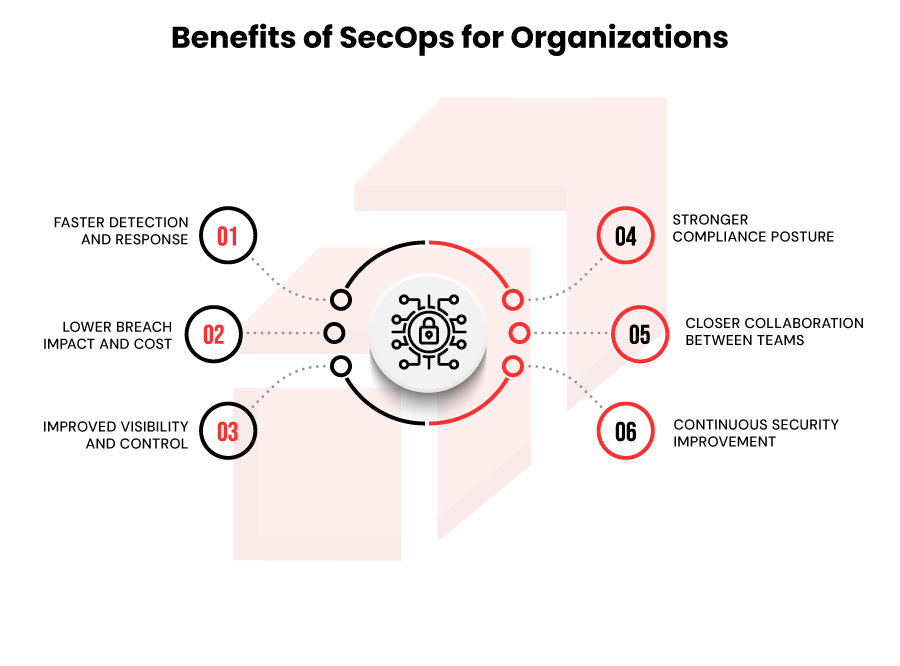
The main benefits of SecOps include:
1.Faster detection and response: Continuous monitoring plus clear playbooks significantly reduce the time to detect and contain attacks, limiting damage.
2.Lower breach impact and cost: Early containment means fewer systems affected, less downtime, and smaller legal and remediation bills.
3.Improved visibility and control: A central SecOps function consolidates data from endpoints, networks, apps, and cloud, making risk easier to understand and prioritise.
4.Stronger compliance posture: Proper logging, incident documentation, and monitoring evidence make audits smoother and help meet regulatory obligations.
5.Closer collaboration between teams: SecOps gives security and operations shared goals and workflows, reducing friction between “move fast” and “stay secure”.
6.Continuous security improvement: Regular tuning of detections and playbooks ensures the organisation becomes harder to attack over time instead of stagnating.
Best SecOps Tools to Support Security Operations
Effective SecOps tools fall into several functional categories. The goal is to choose tools that integrate well rather than collecting overlapping point solutions.
SecOps Tool Categories Overview
| Tool Category | Primary Purpose | Typical Use in SecOps |
| SIEM | Aggregate and correlate logs/events from across the environment. | Central detection engine, investigations, dashboards, and compliance reporting. |
| SOAR | Automate and orchestrate response workflows. | Run playbooks that enrich alerts, open tickets, block users, or isolate devices. |
| EDR / XDR | Monitor and protect endpoints and workloads. | Detect and contain malware, ransomware, and suspicious behavior on devices and servers. |
| Cloud security monitoring / CSPM | Continuously assess cloud configurations and identities. | Find misconfigurations, exposed data, and risky privileges in AWS, Azure, and GCP. |
| Log management & alerting | Collect and store logs at scale with search and alerts. | Provide raw data for SIEM, forensics, and longterm retention needs. |
How these tools help:
- SIEM tools: Deliver correlation rules, threat detection, and a single source of truth for alerts and incident timelines.
- SOAR platforms: Remove manual toil from SecOps by automating enrichment, containment steps, and notifications based on playbooks.
- Endpoint Detection & Response (EDR/XDR): Give deep visibility into what is happening on laptops, servers, and cloud workloads, and allow rapid isolation of compromised hosts.
- Cloud security monitoring tools (CSPM/CNAPP): Focus on cloud misconfigurations, vulnerabilities, and identity risks specific to IaaS/PaaS environments.
- Log management and alerting tools: Ensure scalable, cost‑effective collection and retention of logs so investigations and compliance are possible.
Rapyder’s view: choose one strong platform in each category that integrates cleanly with your primary cloud and existing stack, rather than many partially used products. For example, pair a cloud‑aware SIEM with a CSPM tailored to AWS, then plug alerts into SOAR and ITSM for consistent workflows.
SecOps Best Practices
- Centralise visibility early. Aggregate logs and alerts from endpoints, networks, applications, and cloud into a unified view so analysts do not chase threats in five consoles.
- Define and test runbooks. Document incident procedures for common scenarios -phishing, ransomware, data exfiltration – and rehearse them through tabletop exercises.
- Automate repetitive steps. Use SOAR and scripting to handle predictable tasks like enrichment, blocking IOCs, or disabling suspicious accounts, freeing analysts for deeper work.
- Integrate SecOps with DevOps and cloud teams. Embed security checks into CI/CD, infrastructure‑as‑code, and change management so issues are prevented, not just detected.
- Measure meaningful KPIs. Track metrics such as MTTD, MTTR, incident volume by severity, and coverage of critical assets to guide investments and improvements.
- Review and refine regularly. After every major incident or drill, update detection content and playbooks to address gaps exposed in real‑world scenarios.
Rapyder emphasizes cloud‑first SecOps best practices like agentless cloud posture assessments, prioritized remediation plans, and regular joint reviews with customer teams to keep controls aligned with evolving threats and business needs.
Strengthen Your Security Operations with Rapyder SecOps
Rapyder’s SecOps offering focuses on securing cloud infrastructure and workloads with continuous risk assessment, cloud‑native monitoring, and expert guidance. The service surfaces misconfigurations, vulnerabilities, and identity risks in AWS and other environments, then provides clear prioritization and remediation recommendations mapped to business impact.
Get Your Free Cloud SecOps Assessment →
Working alongside Rapyder’s managed cloud and DevOps services, SecOps capabilities include:
- Ongoing cloud security posture assessments using agentless scanning and benchmarks.
- Integration of findings into existing ticketing and monitoring tools so issues are tracked to closure.
- Advisory and incident support helps internal teams improve processes, not just fix individual alerts.
For organisations that lack a full in‑house SOC or need cloud‑specific expertise, Rapyder effectively becomes an extension of the security team.
Conclusion
SecOps is the operational core of modern cybersecurity: a continuous function that blends monitoring, detection, and incident response across on‑prem, cloud, and SaaS. Understanding the secops meaning helps organizations build a stronger security posture by moving from reactive fixes to proactive, always-on defense By investing in clear SecOps roles and responsibilities, cloud‑aware tooling, and disciplined SecOps best practices, organisations gain faster detection, lower breach impact, better compliance, and stronger customer trust.
Pairing that foundation with a partner like Rapyder for cloud SecOps helps teams move from reactive security responses to a structured, measurable security operations program that can keep up with today’s nonstop threat landscape.