AWS Graviton processors are purpose-built chips that bring stronger performance, lower costs, and better energy efficiency to modern cloud workloads. In this blog, we’ll break down what Graviton is, how it has rapidly evolved across generations, why businesses are adopting it so fast, and a practical, step-by-step path to help you migrate your applications to this powerful architecture.
What Is AWS Graviton?
AWS Graviton is a family of 64-bit Arm-based processors custom-built by Amazon Web Services to deliver the best price-performance for cloud workloads running in Amazon EC2.
A Brief History
Annapurna Labs to a Cloud Computing Revolution
The Graviton story began with AWS’s 2015 acquisition of Annapurna Labs, a semiconductor company. This allowed AWS to design custom silicon, starting with the Nitro System and eventually leading to the Graviton chip family, launching a cloud computing architecture revolution.
Evolution of Graviton
The First Leap: AWS Graviton1
Launched in 2018 with the A1 EC2 instances, Graviton1 was a proof-of-concept. It was based on the Arm Cortex-A72 cores and was best suited for scale-out workloads like web servers and containerized microservices.
AWS Graviton2: From Innovation to Industry Standard
Introduced in 2019, Graviton2 offered up to 40% better price-performance than comparable x86 instances. It used high-performance Arm Neoverse N1 cores, leading to its widespread adoption across many EC2 instance types.
Pushing the Boundaries: The Performance Gains of AWS Graviton3
Released in 2022, Graviton3 further enhanced performance by up to 25% over Graviton2. It featured high-performance Arm Neoverse V1 cores and was the first to support the energy-efficient DDR5 memory.
What’s Next? A Glimpse into the Future with AWS Graviton4
Announced in 2023, Graviton4 delivers up to 30-40% better performance than Graviton3 for various workloads. It offers increased core counts and memory bandwidth, further setting the standard for cloud computing efficiency.
Benefits of AWS Graviton
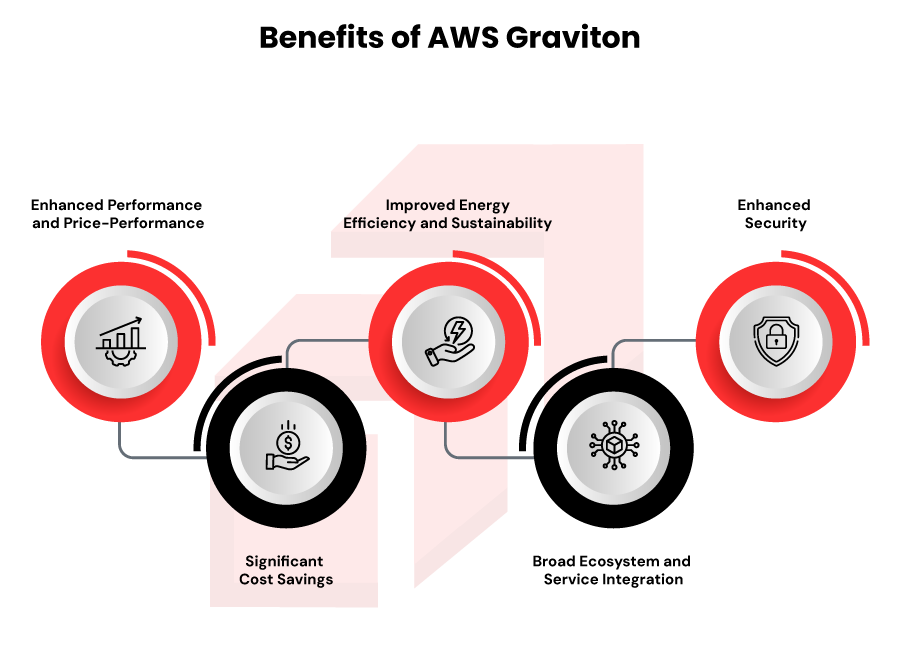
Enhanced Performance and Price-Performance
Graviton processors deliver a substantial uplift in performance while costing less than comparable x86 instances, resulting in up to 40% better price-performance for a broad range of applications. Graviton processors deliver a substantial uplift in performance while costing less than comparable instances, resulting in better price-performance for a broad range of applications.
Significant Cost Savings
Due to their custom design and optimized efficiency, Graviton-powered instances generally have a lower hourly price than their x86 counterparts, leading to substantial cost reduction in your cloud bill.
Improved Energy Efficiency and Sustainability
Graviton instances use up to 60% less energy for the same performance. This dramatically reduces your compute workload’s carbon footprint, helping meet your organization’s sustainability goals.
Broad Ecosystem and Service Integration
The Graviton ecosystem is mature, with support from popular Linux distributions, extensive open-source software, and deep integration across many core AWS Managed Services.
Enhanced Security
Graviton processors are built on the AWS Nitro System and include security features like always-on memory encryption and dedicated core caches, which improve data protection and isolation.
Where Can You Use AWS Graviton?
Amazon EC2 Instances: A Breakdown of Graviton-Powered Options
Graviton powers various EC2 instance families: M7g (General Purpose), C7g (Compute Optimized), and R7g (Memory Optimized), giving you choice for a wide array of workloads.
Managed Services Supercharged by Graviton
Beyond EC2, Graviton processors enhance many core AWS managed services. This provides out-of-the-box price-performance benefits for databases, caching, serverless computing, and containers without requiring extensive code changes from the user.
Amazon RDS for High-Performance Databases
Amazon RDS (Relational Database Service) and Amazon Aurora support Graviton, offering significant performance improvements and cost savings for relational database workloads.
Amazon ElastiCache for In-Memory Caching
Graviton-powered nodes in Amazon ElastiCache provide better price-performance for in-memory caching use cases, improving the speed and responsiveness of data access.
Amazon OpenSearch Service for Log Analytics and Search
Running Amazon OpenSearch Service (for search and analytics) on Graviton instances delivers better indexing, query performance, and lower costs for data-intensive logging and search workloads.
AWS Lambda for Serverless Computing
AWS Lambda functions running on Graviton can deliver up to 19% better performance at a 20% lower cost, making it the superior choice for most serverless compute workloads.
Amazon EKS for Containerized Applications
Graviton provides an excellent platform for containerized applications managed by Amazon EKS or ECS, leading to highly scalable, cost-effective, and efficient microservices architectures.
Is Graviton Right for You? Identifying the Ideal Use Cases and Workloads
Web Servers and Application Servers
Graviton instances are ideal for serving web traffic and running application logic due to their superior price-performance for scale-out, high-throughput workloads.
Microservices and Containerized Applications (Docker, Kubernetes)
The efficiency of the Arm architecture makes it perfect for microservices, Docker containers, and Kubernetes clusters, where minimizing the cost per service is crucial.
High-Performance Computing (HPC)
With the enhanced memory bandwidth and high core counts of Graviton3/4, demanding workloads like scientific simulations and complex financial modelling are accelerated.
Data Analytics and Big Data Processing
Graviton is well-suited for Apache Spark and similar frameworks. It provides a more cost-effective and faster compute environment for processing large datasets in services like Amazon EMR.
In-Memory Caches and Databases
For memory-intensive workloads like Redis, Memcached, and open-source databases, the Graviton family offers better performance and significantly reduces the total cost of ownership.
The Migration Journey: A Practical Guide to Moving to AWS Graviton
Migrating to AWS Graviton – ARM-based processors that can deliver up to 40% better price-performance – follows a simple four-step journey: Assess what’s ready, test workloads on Graviton, optimize for ARM64, and roll out gradually into production.
PHASE 1 – Assess
What to do:
- Identify workloads, runtimes, libraries, and dependencies
- Check ARM64 compatibility (frameworks, containers, third-party tools)
- Benchmark current performance + cost
Why it matters: You’ll know exactly what’s ready today and where the effort lies.
PHASE 2 – Test
What to do:
- Spin up Graviton-based EC2/ECS/EKS/Lambda test environments
- Run load tests and compare CPU, memory, latency, throughput
- Fix small gaps: rebuild containers, update libraries, tweak configs
Why it matters: This builds confidence with real numbers, not assumptions.
PHASE 3 – Optimize
What to do:
- Enable ARM64 builds in your CI/CD
- Use multi-arch containers
- Tune autoscaling, memory settings, and app parameters
Why it matters: You squeeze out the performance-per-cost advantage Graviton is known for.
PHASE 4 – Roll Out
What to do:
- Use blue/green or canary releases
- Shift traffic gradually (10% → 50% → 100%)
- Validate monitoring, logging, security agents
Why it matters: Smooth cutover, zero surprises.
PHASE 5 – Scale & Save
What to do:
- Migrate remaining environments
- Rightsize instances based on new performance
- Apply Savings Plans + Spot where suitable
Why it matters: You unlock the full 20–40% cost benefit.
Getting Started with AWS Graviton: Your First Steps
The journey to superior price-performance starts here. While the path involves assessment, recompilation, and validation, Rapyder specializes in making this transition seamless, secure, and highly optimized.
- Assessment & Workshops: We evaluate your current workloads to identify the maximum cost savings and performance uplift.
- Migration & Upgrades: We facilitate the smooth migration of your workloads to the latest Graviton processors, ensuring minimal disruption and adherence to best practices.
- Managed Services: We offer 24/7 expert support and optimization for your new Graviton workloads, guaranteeing continuous peak performance and cost control.
AWS Graviton processors help run cloud apps faster and more cheaply, making them a smart choice for companies that want to lower costs and save energy when using AWS for things like websites, databases, and machine learning.
Stop optimizing legacy hardware and start building the future of your cloud.
Contact Rapyder’s Graviton experts today!