
Most enterprise AI spend today goes toward making a model talk. Summarise this ticket. Draft that reply. Explain the anomaly. But a surprising share of production AI calls are not asking for prose at all. They are asking a question with a fixed set of answers: is this lead qualified, which team owns this ticket, does this invoice match the PO, should this request escalate?
For those calls, you are paying a generative model to write a sentence you will immediately parse back into a value. A new category of model has emerged to address exactly that mismatch. TypeSafe AI Jev is the one that just went public, and it is worth understanding before the vendor claims settle.
What TypeSafe AI Jev Changed in September
On 15 September 2026, a San Francisco lab called TypeSafe AI came out of stealth with $40M in seed funding and a model named Jev. The founder, Diogo Almeida, is a co-author of the InstructGPT paper and is credited by TypeSafe as a co-inventor of RLHF and InstructGPT, so the pedigree is not in question.
Jev does not generate text. You send it a state and a set of typed questions, and it returns typed decisions with probabilities and a confidence estimate. There are three question types: pick an option from a list, score against a rubric, or evaluate whether a statement is true. All of them can be asked in a single call, evaluated in parallel, in roughly 70 to 500 milliseconds, priced at $42 per billion input tokens with output free.
TypeSafe calls this a System One model, borrowing Kahneman’s fast, intuitive thinking as distinct from slow deliberation. The model name comes from William Stanley Jevons, whose paradox holds that falling cost drives rising consumption.
The category framing matters more than the specific product. What is being proposed is that the decision layer of your AI stack should be architecturally separate from the generation layer. That is a shift in enterprise AI architecture, not just a new model to swap in.
The Architectural Argument
Consider a support desk processing 50,000 tickets a month. Today, a typical LLM-based pipeline sends every ticket to a chat model with a structured-output instruction, gets JSON back, parses it, and routes. The model spends most of its compute producing tokens you discard.
The decision-model pattern inverts this. A cheap classifier sits at the front of the queue, makes the routing and priority calls in milliseconds, and only the tickets that need drafting, summarising or reasoning ever reach an expensive model. You are not replacing your LLM. You are stopping it from being asked questions it is overqualified for.
This pattern generalises well beyond support. Lead scoring on inbound forms. Document triage before retrieval. Guardrails on agent tool calls. LLM routing, where a cheap judgment decides whether a request needs your most capable model or your fastest one.
It is a good argument. It is also worth separating from the claims made on its behalf.
Where the Evidence Is Thinner Than the Marketing
TypeSafe’s homepage leads with 193.6x faster and 444.6x cheaper. The cost side holds up under independent testing. The speed multiple does not reconcile against real deployments: Vercel’s own CEO has reported roughly 18x faster at p95 on an actual production safety-review step. That is still meaningful, but a long way from 193.6x, and the best-grounded real-world number available so far.
The accuracy picture needs more care. TypeSafe’s public benchmark covers 711 cases across four workflows, and the company discloses that the reference answer is the average judgment of two frontier LLMs. That measures agreement with other models rather than correctness against ground truth. Even on that benchmark, Jev trails its comparators on the accuracy column, most sharply on invoice processing at 61.8% against 79.1% for a frontier model.
An independent, reproducible benchmark published two days after launch is more instructive. Run against 2,000 phishing and legitimate emails, Jev scored 62.6% when asked a single question, against 81.3% for Claude Haiku 4.5. But when the author decomposed the same judgment into five narrow signal questions and fitted weights on half the data, performance reached 95.0% on the held-out half.
That gap is the single most useful thing to take from the launch. Accuracy in this paradigm is something you engineer, not something you purchase.
“Zero Hallucinations” Needs an Asterisk
TypeSafe states that Jev cannot hallucinate, and in a narrow sense that is true. If the permitted answers are Billing, Technical and Sales, the model cannot invent Legal. The output is constrained by schema.
It can still return Billing when Technical was correct. The guarantee is zero out-of-schema outputs, not zero wrong decisions, and conflating the two will get someone burned.
TypeSafe’s own limitations documentation is refreshingly direct about the rest: weakness on counting, arithmetic, dates, multi-step indirection and noisy inputs, plus vulnerability to adversarial instructions embedded in the supplied material. That last one deserves attention, because the showcase use cases involve inputs that attackers control.
There is also a quirk worth knowing. Documented examples show the same question phrased two ways returning materially different probabilities, and a question and its negation receiving values that do not sum as a developer would expect. Each question is evaluated independently. Do not treat the outputs as a coherent joint probability model.
What Enterprises Should Do About It
If you are running high-volume, repeatable judgments through a chat model today, this category deserves a pilot. The honest experiment takes a week.
Take 200 to 500 historical cases where you know the real outcome. Score them three ways: with a decision model, with a cheap LLM using constrained output, and with whatever rules you have now. Compare against your labels, not against anyone’s benchmark. Decompose the judgment into separate signals rather than asking one compound question, because that is where the measured difference lives.
Then look at the confidence distribution. Early independent tests suggest calibration should be measured on your own data before automation thresholds are trusted, which points to an obvious design: act automatically above a high threshold you have verified, route everything else to a human or to a larger model. The economics still work, because the expensive path only runs on the ambiguous minority.
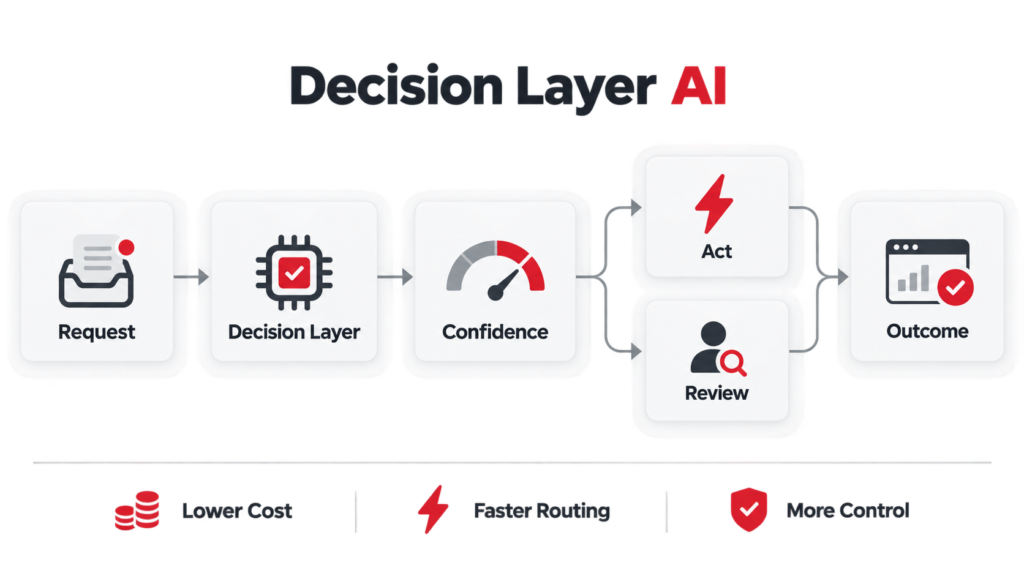
Budget for the parts that are not inference. You will design the decision graph, define labels, set thresholds, decide what low confidence triggers, and build an evaluation harness. Token cost falls sharply. Engineering and evaluation work goes up. The vendor’s cost multiple counts only the first of those.
The Reasonable Conclusion
The defensible claim is that TypeSafe has pushed the speed and cost frontier for structured decisions a long way out. That is genuinely significant for anyone running AI at volume. It is a different claim from having built a model that rivals frontier systems on judgment quality, and the launch materials blur the two.
For enterprises, the takeaway is architectural rather than vendor-specific. Audit where your AI spend goes. If a meaningful share is buying prose you throw away, the decision layer is a real AI cost optimization opportunity, and it is now cheap enough to test in an afternoon.
How This Helps Rapyder Clients
For Rapyder clients, the real opportunity is not replacing every workflow with a large conversational AI model. It is knowing where a smaller, faster decision layer can do the job better.
Many enterprise AI workflows do not need long-form generation. They need a reliable answer to a narrow business question: approve or escalate, route to the right team, classify the request, flag risk, score urgency, or decide whether a document needs human review. That is the same principle behind good intent routing on Amazon Bedrock AgentCore, and the same discipline behind any production-grade agentic AI architecture: classify before you generate, and only let the expensive path run when the request actually needs it.
By placing a lightweight decision layer in front of expensive GenAI workflows, Rapyder helps clients reduce unnecessary model calls, improve response time, and create cleaner governance around AI-led actions. A few examples of where this shows up in practice:
- In BFSI, it can help route claims, detect policy exceptions, or flag high-risk cases for review.
- In ecommerce, it can classify customer intent, identify refund risk, or prioritize support tickets.
- In healthcare, it can triage non-clinical queries, route documents, or escalate sensitive cases.
- In enterprise operations, it can decide whether a task needs automation, human approval, or a full GenAI response.
Rapyder’s role is to architect this safely, vendor-neutral. That means auditing where GenAI spend is actually going and which calls are decisions in disguise: the summarise, draft and explain calls that are really just feeding a downstream if/else. It means building the evaluation harness that tests any decision layer, a model like Jev included where the evaluation actually supports it, against the client’s own labelled cases rather than a vendor benchmark.
It also means architecting the routing layer itself, whether on AWS-native services like Amazon Bedrock and AWS Lambda, or by integrating a third-party decision model where the evaluation supports it.
The right production architecture includes:
- Confidence-threshold routing
- Human-in-the-loop escalation
- Model fallback paths
- Decision observability
- Latency and cost tracking
- Downstream accuracy measurement
- Governance around which decisions can be automated
The business value is simple: clients get faster AI workflows, lower GenAI costs, fewer unnecessary escalations, and more control over where large models are actually used. Decision-first AI does not replace enterprise GenAI. It makes enterprise GenAI more practical, measurable and production-ready.
If your assistant is answering every question the same way, and costing the same for all of them, the fix probably is not a bigger model. It may be a better decision layer.
Talk to Rapyder’s GenAI team
Frequently Asked Questions
Jev, built by TypeSafe AI, is a System One model. Instead of generating text, it takes a state and a set of typed questions and returns typed decisions, such as a choice from a list, a rubric score or a true/false judgment, with a calibrated probability. A typical LLM like ChatGPT generates prose that then has to be parsed back into a structured value. Jev skips that step entirely.
In a narrow, technical sense, yes: because Jev’s output is constrained to a fixed schema, it cannot invent an answer outside the permitted options. But that guarantees zero out-of-schema outputs, not zero wrong decisions. It can still confidently pick the wrong valid option. Treat zero hallucinations as a claim about output format, not about accuracy.
It depends heavily on how the question is asked. On TypeSafe’s own benchmark, Jev trails frontier models on several tasks, most notably invoice processing at 61.8% vs. 79.1%. An independent test on 2,000 phishing emails found Jev scored 62.6% against 81.3% for Claude Haiku 4.5 when asked a single question. But decomposing that one compound question into five narrower signal questions raised accuracy to roughly 95% on held-out data. Accuracy in this category is something you engineer through question design, not something you get by default.
The cost advantage holds up under independent testing: Jev is priced well below typical LLM inference for structured decisions. The headline speed claim, 193.6x faster, does not fully reconcile with real deployments. Vercel’s CEO has reported roughly 18x faster at p95 on an actual production step, the most credible real-world number available so far. Both cost and speed are worth testing on your own traffic rather than taking the marketing number at face value.
Any high-volume, repeatable judgment that currently goes through a chat model just to get a structured answer back: ticket routing and priority, lead qualification, invoice-to-PO matching, escalation decisions, document triage before retrieval, and guardrails on what an agent is allowed to do next.
Score 200 to 500 historical cases with a known outcome three ways: a decision model, a cheap LLM with constrained output, and your existing rules. Compare all three against your own labels, not a vendor’s benchmark. Decompose compound judgments into separate signal questions, since that is where most of the measured accuracy gain comes from. Then look at the confidence distribution: act automatically above a high-confidence threshold, and route everything else to a human or a larger model.
It sits ahead of the reasoning and generation layers, doing the classification and LLM routing. Cheap, fast judgments decide which requests need a full agent or LLM call at all, and which can be resolved or routed on a typed decision alone. That keeps token spend concentrated on the requests that actually need it. This is the same intent-routing principle used in production agentic systems like those built on Amazon Bedrock AgentCore.
Rapyder helps enterprises across BFSI, ecommerce, healthcare and enterprise operations audit where their GenAI spend is going, build the evaluation harness needed to test a decision model against their own data, and architect the routing layer itself. That can include intent routing on Amazon Bedrock AgentCore, a custom decision layer on AWS-native services, or integrating a third-party model like Jev where the evaluation supports it, with confidence-threshold routing, observability and a documented fallback path built in from the start.