Healthcare is experiencing a revolutionary transformation. Agentic AI in healthcare represents autonomous systems that make independent decisions, coordinate workflows, and continuously learn – going beyond traditional reactive AI tools.
Key Market Facts:
- 94% of healthcare organizations use AI technology
- AI in healthcare market: USD 36.96B (2025) → USD 613.81B (2034) at 36.83% CAGR.
- Post-pandemic acceleration: Telemedicine usage jumped from <1% to 43.5%.
What is Agentic AI in Healthcare & How Is It Different from Other AI Models?
Agentic AI in healthcare refers to intelligent systems that can perceive medical environments, make context-aware decisions, take actions, and continuously learn from outcomes—all with minimal human intervention.
Unlike conventional AI models that mainly provide predictions or insights, agentic AI goes a step further by executing tasks autonomously, such as scheduling follow-ups, optimizing treatment plans, or monitoring patient vitals in real time.
AI Evolution Comparison:
| AI Type | Capability | Healthcare Role |
| Traditional AI | Reactive analysis | Diagnostic assistance when prompted |
| Generative AI | Content creation | Report generation, information synthesis |
| Agentic AI | Autonomous action | Independent decision-making and coordination |
Agentic AI Distinguishing Features:
- Self-initiated actions based on patient condition changes
- Multi-departmental coordination across healthcare systems
- Continuous learning from clinical outcomes
- Complex decision-making with multiple variable analysis
- End-to-end workflow execution without step-by-step human guidance
Example: Traditional AI flags abnormal vitals → Agentic AI assesses severity, prioritizes cases, initiates diagnostics, alerts specialists, and monitors continuously – all autonomously.
Role of Agentic AI in Healthcare
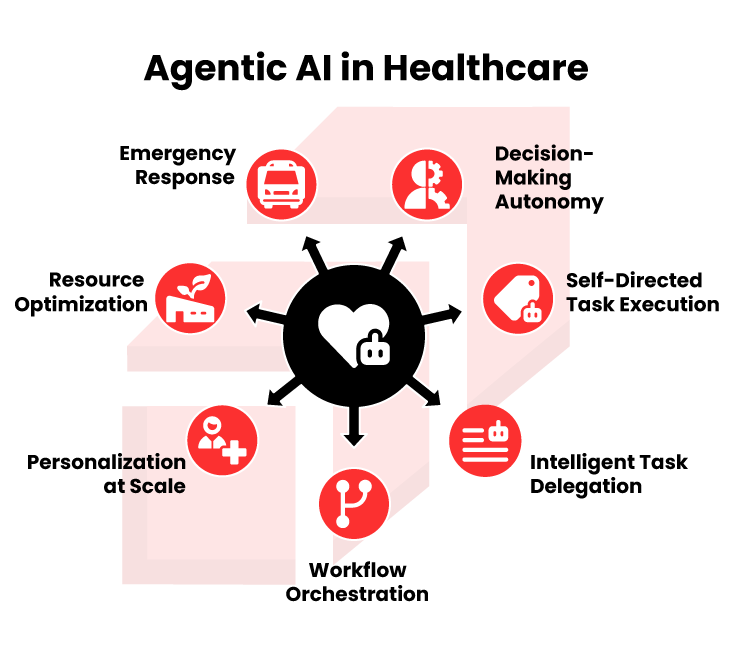
Seven Core Autonomous Capabilities:
- Decision-Making Autonomy
- Real-time clinical decisions without human prompts
- Monitors 100+ patient variables simultaneously
- 85% accuracy in predicting critical events like sepsis
- Self-Directed Task Execution
- Automated diagnostic workflows and EHR updates
- Test ordering and specialist notifications
- Regulatory compliance through audit trails
- Intelligent Task Delegation
- Dynamic workload distribution based on team capacity
- Expertise matching for optimal outcomes
- Prevents burnout through intelligent resource allocation
- Workflow Orchestration
- Cross-departmental coordination (lab, radiology, pharmacy)
- Bottleneck prediction and patient flow optimization
- 40% reduction in administrative errors
- Personalization at Scale
- Individualized treatment plans using comprehensive patient data
- 99% accuracy in treatment recommendations
- Real-time adaptation based on patient responses
- Resource Optimization
- Patient load balancing and demand forecasting
- Supply chain logistics optimization
- Cost reduction through predictive analytics
- Emergency Response
- Early risk identification for critical conditions
- Autonomous intervention protocol activation
- Continuous monitoring during emergencies
Key Benefits of Agentic AI in the Healthcare Industry
Automating Clinical Workflows
Agentic AI can take over time-consuming administrative tasks such as patient intake, scheduling, and insurance verification, leading to up to 30% time savings on routine tasks and a 60% reduction in documentation time. By streamlining these workflows, clinicians are freed from repetitive processes, allowing them to dedicate more attention to direct patient care.
Real-Time Diagnostics Support
With “always-on” diagnostic capabilities, Agentic AI assists healthcare providers in detecting critical conditions within minutes, ensuring timely interventions. Its continuous monitoring reduces the chances of missed findings, enabling zero-error detection in autonomous monitoring systems. This real-time support strengthens diagnostic accuracy and enhances patient safety.
Personalized Treatment Plans
Agentic AI analyzes comprehensive patient data, including medical history, lifestyle patterns, and even genetic predispositions, to design tailored treatment strategies. By factoring in these layers of information, it achieves expert-level accuracy in pathology screening, helping clinicians deliver therapies that are more precise, targeted, and effective for each patient.
Improved Operational Efficiency
From resource allocation to patient management, Agentic AI significantly boosts efficiency across healthcare systems. Studies show it can deliver 20–40% workflow improvements, while achieving 97% accuracy in intent recognition for automated systems. These improvements translate into measurable cost savings for healthcare providers and enhanced satisfaction for both staff and patients.
Reduced Errors and Clinician Burnout
Automation powered by Agentic AI reduces the risk of medical errors and lightens clinicians’ workload, which contributes to better overall patient outcomes. Industry estimates suggest $200–360 billion in savings through automation, alongside a 35% improvement in patient outcomes. By easing documentation and routine tasks, clinicians can focus on complex decision-making and compassionate patient care, reducing burnout and improving morale.
Agentic AI in Healthcare Examples & Use cases
- AI Agents in Radiology
- Real-time emergency scan monitoring with automatic critical finding detection
- Independent case prioritization reducing interpretation delays
- Mammography pre-screening improving cancer detection rates.
- AI in Drug Discovery
- 70% reduction in discovery timelines
- Autonomous molecular interaction analysis and hypothesis testing
- Continuous literature mining for compound identification.
- Virtual Nursing Assistants
- 24/7 patient communication and medication management
- Adaptive responses based on patient history
- Automatic escalation to human clinicians when needed.
- Robotic Surgery
- Video-based learning achieving human-level precision
- Independent problem-solving during procedures
- Collaborative surgical support anticipating surgeon needs.
- Smart ICU Monitoring
- 100+ variable monitoring with hours-early sepsis prediction
- Autonomous rapid response activation
- Significant mortality reduction in critical care.
- Insurance Claims Automation
- Autonomous processing and eligibility verification
- Continuous learning for improved approval rates
- Complex scenario handling including appeals.
Why the Agentic AI Healthcare Market Is Booming
Explosive Market Growth
The healthcare AI market is experiencing unprecedented growth, with projections showing a surge from USD 36.96 billion in 2024 to over USD 613.81 billion by 2034. According to industry reports from Frost & Sullivan, McKinsey, and Gartner, healthcare AI startups are receiving a significant premium—up to 83% higher valuations compared to traditional healthcare companies. Funding has also hit record highs, with USD 23 billion invested in 2024 alone, signaling strong investor confidence in AI-driven healthcare solutions.
Post-Pandemic Digital Acceleration
The COVID-19 pandemic was a turning point for digital healthcare adoption. Telemedicine visits skyrocketed from less than 1% to nearly 43.5% of total consultations, showcasing how digital-first healthcare quickly became mainstream. The crisis also highlighted the need for autonomous and agentic systems to address staff shortages and scale care delivery. Today, 79% of healthcare organizations report using AI technology in some capacity, underscoring its permanent role in healthcare transformation.
Investment & Government Support
Both private and public sectors are fueling the AI healthcare boom. In the past decade, over USD 60 billion has been invested in AI-powered healthcare startups, driving innovation in diagnostics, drug discovery, and patient care. On the policy front, the U.S. government has invested USD 1.7 billion in AI research, while India’s National Digital Health Mission (NDHM) already benefits over 400 million citizens and is projected to grow at 40.6% CAGR, reaching USD 1.6 billion by 2025. These initiatives provide the infrastructure and funding necessary to scale AI adoption in healthcare globally.
Demand for Personalization at Scale
Patients today expect healthcare that is not just accessible but also highly personalized. Agentic AI enables real-time decision-making, adaptive care pathways, and individualized treatment plans that go beyond traditional one-size-fits-all approaches. With rising demand for preventive care, wellness solutions, and precision medicine, agentic AI is emerging as the backbone of scalable, personalized healthcare delivery—meeting both patient expectations and provider efficiency goals.
Leading cloud consulting companies like Rapyder help healthcare organizations implement secure, compliant AI solutions through expert digital transformation guidance.
The Future of Agentic AI in Healthcare
Multi-Agent Hospital Orchestration
- Specialized agent networks coordinating across departments
- Real-time emergency-radiology-pharmacy communication
- Distributed decision-making with human oversight.
Human-AI Care Team Symbiosis
- AI handles routine tasks, humans focus on complex reasoning
- 60% administrative reduction enables more patient interaction
- Hybrid teams with human expertise guiding AI execution.
IoT-Blockchain-AI Integration
- Continuous wearable/sensor data streams
- Secure, decentralized patient data sharing
- Population-scale disease outbreak prediction.
Predictive Prevention Revolution
- Pre-symptom disease detection using comprehensive profiling
- Autonomous prevention strategies and screening coordination
- Community health monitoring and public health response.
How Rapyder Is Helping Customers with Agentic AI
Rapyder helps healthcare organizations move from AI experimentation to real-world, compliant adoption of agentic AI. Our role is to ensure these systems are secure, scalable, and seamlessly embedded into daily workflows.
- Secure Foundations: We design HIPAA-compliant cloud environments with built-in security, governance, and continuous monitoring so sensitive data stays protected.
- AI/ML Enablement: From model training to MLOps, we help teams deploy agentic AI agents that automate tasks like clinical documentation, diagnostics support, and care coordination.
- EHR Integration: Our solutions connect directly with hospital systems, ensuring AI insights appear where clinicians already work – without extra steps.
The impact is tangible: faster deployments, reduced clinician workload, and measurable gains in patient outcomes. With Rapyder as a partner, healthcare providers can confidently scale agentic AI and unlock its full potential.
Conclusion
Agentic AI in healthcare transforms medicine from reactive treatment to proactive, autonomous care orchestration.
Key Impact Points:
- Market explosion: USD 613.81B by 2034 (36.83% CAGR)
- Proven results: 60% documentation reduction, 40% workflow improvements
- Real implementations: Autonomous monitoring, surgery assistance, 24/7 virtual care.
The Transformation:
Post-pandemic digitization + Massive investment + Government support = Autonomous healthcare revolution
Organizations partnering with experienced providers like Rapyder can accelerate agentic AI implementation through secure, compliant infrastructure and expert healthcare transformation guidance.
Agentic AI in healthcare isn’t just technology, it’s the intelligent foundation enabling personalized, efficient care at population scale. As systems continue learning, they become indispensable partners in optimizing health outcomes for all.
The healthcare game-changer is here. Its impact accelerates daily.