Choosing the right database can make or break your application. Two of the most popular NoSQL options today are Amazon DynamoDB and MongoDB. Both are powerful, both handle documents, and both scale horizontally – but they take very different approaches.
In this guide, we’ll break down the key differences between mongodb and dynamodb, side-by-side – data model, performance, scaling, consistency, ecosystem, – so you can pick the one that truly fits your project.
Amazon DynamoDB & Amazon MongoDB
Amazon DynamoDB A fully managed, serverless key-value and document database from AWS. Launched in 2012, it delivers single-digit millisecond latency at any scale. You never manage servers, patches, or clusters – this database handles everything. It auto-scales seamlessly and charges only for what you use.
MongoDB The document database that introduced flexible, JSON-like BSON storage to the world. It’s known for its schema flexibility, expressive query language, powerful aggregation framework, and developer-friendly JSON syntax. With MongoDB Atlas, you can also run it fully managed on different clouds.
They look similar on the surface – both store JSON-like data and scale out. Scratch beneath it, though, and the differences in philosophy, pricing, operations, and trade-offs stand out.
What is Amazon DynamoDB & Its Advantages?
Amazon DynamoDB is AWS’s fully managed, serverless NoSQL database powers some of the most demanding workloads inside Amazon (Prime Day, Alexa, and the retail platform) and is now available to every AWS customer.
It combines a flexible key-value and document data model with complete operational abstraction: no servers, no patches, no sharding, no cluster management – just tables that work.
Key Advantages of DynamoDB
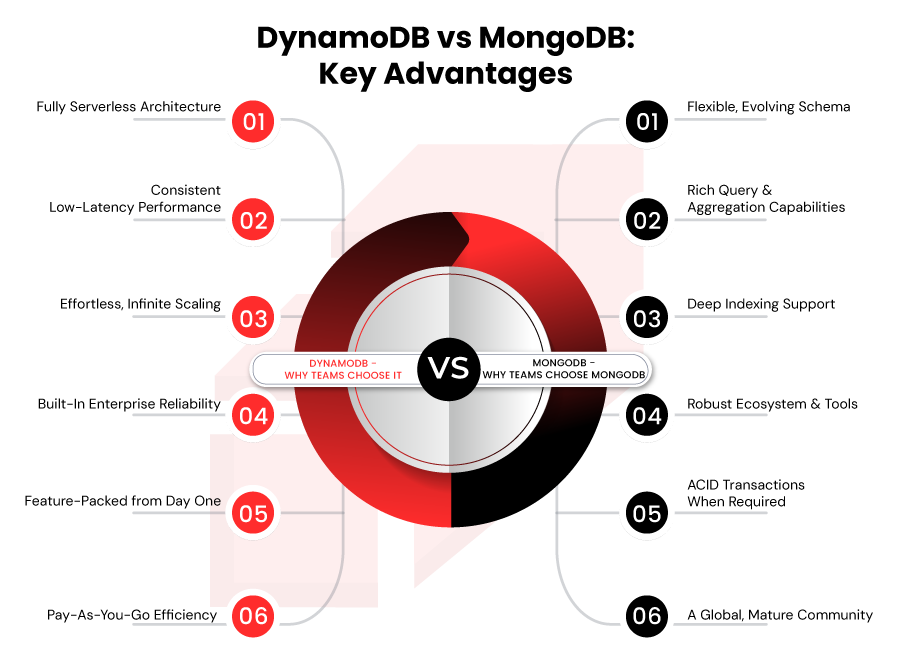
True Serverless Experience: No instances, no clusters, no operational overhead.
Predictable Low Latency: Consistent single-digit millisecond performance, even at massive scale.
Seamless, Unlimited Scaling: On-demand mode eliminates capacity planning entirely; provisioned mode lets you fine-tune when needed. Scale reads/writes instantly without downtime or re-sharding.
Enterprise-Grade Reliability: Automatic multi-AZ replication, 99.999% durability, and a 99.99% availability SLA.
Rich Feature Set Out of the Box
- Global tables (multi-region active-active)
- DynamoDB Streams (real-time change data capture)
- Point-in-time recovery & on-demand backups
- Built-in TTL, transactions, and encryption
- Fine-grained IAM & VPC security controls
Cost Efficiency for Variable Workloads On-demand pricing means you pay per request with zero cost when idle – perfect for startups or spiky traffic patterns.
In essence, DynamoDB lets you focus 100% on your application while AWS guarantees performance, durability, and scalability at any size.
What is MongoDB & Its Advantages?
MongoDB is the original document-oriented NoSQL database that changed how developers think about data. First released in 2009, it stores data as flexible BSON documents (binary JSON) that feel exactly like the JSON objects you already use in your code – no rigid tables, no ORM headaches, and no schema migrations in the traditional sense.
While you can self-host the open-source Community Edition, most teams today choose MongoDB Atlas – the official fully managed cloud service that runs across different cloud platforms with one-click deployment.
Key Advantages of MongoDB
Developer Productivity Superpower: Schema flexibility means you can evolve your data model on the fly. Add new fields, nest objects, or store polymorphic data without downtime or migrations.
Expressive and Powerful Query Language: Query by any field full-text search, geospatial queries, graph traversals, and the legendary Aggregation Pipeline that can replace most backend transformation code.
Rich Indexing Options: Compound, TTL, partial, sparse, text, geospatial, hashed, wildcard – almost every indexing need is covered natively.
Mature Ecosystem & Tools: Compass GUI, Charts, Data Lake, Realm (mobile sync), Triggers, Functions, and official drivers for every major language with identical behavior.
Strong Consistency When You Need It: With multi-document ACID transactions (since v4.0) and readable secondaries, you get the flexibility of NoSQL plus relational-grade guarantees where required.
Vibrant Community & Talent Pool: Over 15 years of real-world usage means tutorials, Stack Overflow answers, and hiring are easier than with most newer databases.
In short, MongoDB is the database that “gets out of your way.” It lets you move fast during early stages, handle complex data shapes gracefully, and still scale to billions of documents when you succeed.
Next, we’ll put them head-to-head into dynamodb vs mongodb – the dimensions that actually matter: core philosophy, primary model, querying, scaling model, management, The real differences are about to get interesting. Keep going!
DynamoDB vs MongoDB: A Side-by-Side Feature Comparison
Now that we’ve covered the basics of each database, it’s time to understand difference between mongodb and dynamodb. While DynamoDB and MongoDB both tackle NoSQL challenges like flexibility and scale, their approaches diverge sharply in design, operations, and trade-offs. To make it crystal clear, we’ve compiled a side-by-side comparison table across the core dimensions that matter most.
Aspect |
DynamoDB |
MongoDB (Atlas) |
Core Philosophy |
Serverless simplicity: Prioritizes predictable performance, zero-ops, and AWS-native scalability for high-velocity apps with known access patterns. | Developer-first flexibility: Emphasizes schema evolution, rich data modeling, and multi-cloud portability for complex, evolving datasets. |
Primary Model |
Key-value with document support: Tables with primary keys (partition + optional sort); JSON-like items up to 400KB, semi-flexible schemas. | Pure document-oriented: BSON collections with fully dynamic schemas; nested arrays/objects up to 16MB per doc, ideal for hierarchical data. |
Querying |
Limited to key-based: Primary/secondary indexes, scans, PartiQL (SQL-like); no native joins -requires app-level assembly or external tools. | Expressive and versatile: Aggregation pipelines, full-text/geospatial/graph queries, $lookup joins; supports ad-hoc and complex analytics natively. |
Scaling Model |
Fully automatic horizontal: Partition-based auto-sharding, on-demand/provisioned throughput; handles millions of reqs/sec with no manual intervention. | Sharded clusters with automation: Horizontal via shard keys; Atlas handles rebalancing/failover, but requires tuning for optimal distribution. |
Management |
Hands-off serverless: AWS manages everything – backups, replication (multi-AZ), patching; global tables for multi-region. | Semi-managed (Atlas): Automates clusters, monitoring, backups; more control but potential ops overhead for custom configs or self-hosting. |
Best For |
High-throughput, low-latency apps in AWS (e.g., e-commerce carts, IoT, serverless like Disney+); predictable keys, minimal ops. | Complex apps needing queries/flexibility (e.g., content mgmt, analytics, catalogs); multi-cloud, rapid prototyping, or evolving schemas. |
This table highlights why there’s no one-size-fits-all – DynamoDB wins on effortless scale and reliability if you’re AWS-bound, while MongoDB edges out on versatility and avoiding lock-in.
A Decision Checklist: When to Choose DynamoDB & MongoDB
Go with DynamoDB if you’re already on AWS (or plan to be), want true serverless with zero database management, need predictable single-digit millisecond latency at any scale, have unpredictable or spiky traffic (think flash sales, IoT, gaming leaderboards), and your queries are mostly key-based (e.g., get user by ID, get orders by customer). It’s perfect when operations overhead must be zero and cost should scale directly with usage.
Pick MongoDB (usually Atlas) if your data model changes often, you store complex nested documents, or you rely on powerful queries like full-text search, geospatial lookups, joins, or heavy aggregation pipelines that would be painful to implement in the application layer.
Bottom line: DynamoDB = maximum performance + zero ops inside AWS.
MongoDB = maximum flexibility + rich features across any cloud (or on-prem).
Get a Data Strategy, Not Just a Database – With Rapyder
Now that you’re clear on whether DynamoDB or MongoDB performance fits your needs, the real win comes from turning that choice into a bulletproof, scalable data foundation. At Rapyder, we don’t just help you pick a database, we design and deliver complete data strategies: seamless migrations (zero-downtime lifts to AWS or multi-cloud), performance tuning, cost optimization, security hardening, real-time analytics, and fully managed operations 24/7.
As an AWS Premier Tier Partner, our experts at Rapyder have guided countless enterprises and startups through the AWS DynamoDB vs MongoDB maze – analyzing every difference between MongoDB and DynamoDB to deliver tailored migrations that handle petabytes of data with zero surprises.
We dive deep into DynamoDB vs MongoDB performance benchmarks to ensure your workloads hit peak efficiency, while optimizing DynamoDB vs MongoDB cost models for scalable, budget-friendly outcomes that evolve with your business. Stop treating your database as a one-off decision in the DynamoDB vs MongoDB showdown. Build a holistic data strategy that grows with you – contact us today for predictable results and unstoppable innovation.
Conclusion
The DynamoDB vs MongoDB debate never truly ends – it just evolves. In the end, it’s simple: choose DynamoDB when you want unbreakable performance and zero operations inside AWS. Choose MongoDB when you need schema freedom, powerful queries, and the flexibility to run anywhere. Make the call that fits your team, your workload, and your future – then commit fully.
Now go build something unstoppable.