Amazon Web Services Simple Notification Service (SNS) and Amazon Web Services Simple Queue Service (SQS) serve as fundamental messaging infrastructure for distributed systems in the cloud. This SQS vs SNS comparison is essential for architects building scalable, event-driven systems. Both fully managed messaging services address different architectural patterns within modern applications.
SNS operates as a publish/subscribe system that broadcasts messages to multiple subscribers, while SQS functions as a traditional message queue enabling point-to-point communication between application components. Together, they form the backbone of scalable, event driven architectures that power millions of applications across industries worldwide. Understanding SNS vs SQS helps teams choose the right service based on delivery model, persistence, and processing requirements.
Amazon Web Services Simple Notification Service (SNS) and Its Features
Amazon Simple Notification Service represents AWS’s flagship pub/sub messaging solution, designed for broadcasting messages across multiple communication channels and subscribers. SNS pushes messages immediately to subscribed endpoints including AWS lambda functions, SQS queues, HTTP endpoints, email addresses, SMS recipients, and mobile push notifications.
The service supports two distinct topic types: Standard topics offer high throughput with best-effort ordering, while FIFO topics enforce strict message ordering and exactly-once delivery, though they’re limited to SQS FIFO queues as subscribers. Key features include sophisticated message filtering capabilities that allow subscribers to receive only relevant messages and automatic scaling that supports thousands of simultaneous subscriptions.
SNS excels at real time notifications and enables seamless integration with other AWS services, making it essential for applications requiring instant message distribution across diverse endpoints and protocols.
Amazon Web Services Simple Queue Service (SQS) and Its Features
Amazon Simple Queue Service functions as a highly durable, fully managed messaging service that enables reliable communication between distributed application components. Unlike SNS’s immediate delivery model, Amazon SQS stores messages for configurable periods ranging from one minute to fourteen days, ensuring guaranteed message processing even when consumers are temporarily unavailable.
The service offers two queue types: Standard queues provide nearly unlimited throughput with at least once delivery and best-effort ordering, while FIFO queues guarantee exactly-once processing with strict first-in-first-out ordering, supporting 300-3000 messages per second. SQS supports batch processing for improved efficiency, configurable visibility timeouts that prevent duplicate processing. Consumers retrieve messages through polling mechanisms, allowing them to process messages at their own pace. The service integrates seamlessly with AWS lambda functions, EC2 instances, and other AWS services, providing the reliable message processing foundation required for asynchronous communication and microservices architectures.
Difference between AWS SQS and SNS
The fundamental differences between SNS and SQS stem from their distinct messaging models and delivery approaches. In an SNS vs SQS architecture, SNS operates on a push-based publisher-subscriber model where messages are immediately delivered to all subscribed endpoints simultaneously, while SQS uses a pull-based queue system where only one consumer retrieves and processes each individual message. This architectural distinction creates significant implications for message persistence, delivery guarantees, and use case suitability.
Feature |
Amazon SNS |
Amazon SQS |
| Messaging Model | Pub/Sub (one-to-many) | Queue (one-to-one) |
| Delivery Method | Push to multiple subscribers | Pull by single consumer |
| Message Persistence | No storage, immediate delivery | Stores messages up to 14 days |
| Supported Protocols | HTTP/S, Email, SMS, Lambda, SQS | AWS APIs, Lambda functions |
| Ordering Guarantees | FIFO topics only | Standard and FIFO queues |
| Batching Support | Individual messages | Batch operations supported |
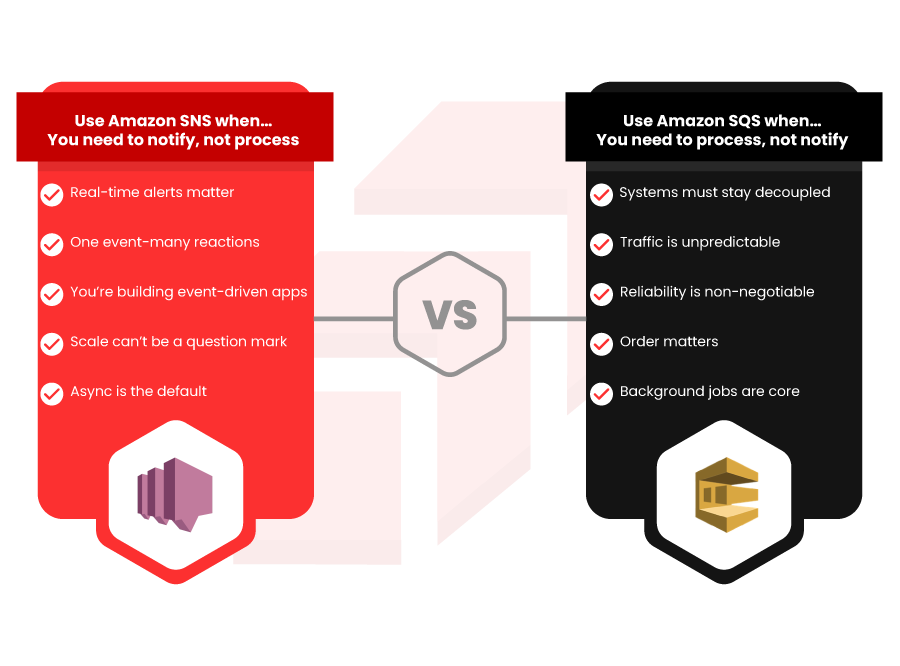
SQS vs SNS: When to Use Each AWS Messaging Service
Amazon SNS is your go-to when you need to get information from one system to many quickly, reliably, and without building complex plumbing yourself. It shines in scenarios where messages need to fan out to multiple services or teams at once, whether that’s triggering workflows, alerting users, or passing events across distributed applications.
You’ll want to use SNS when:
- Real-time alerts matter. Think incident notifications, status updates, or operational alarms that need to hit Slack, email, SMS, or other channels instantly.
- Multiple systems should react to a single event. When one event needs to trigger several actions. A new order, for instance, can alert billing, adjust inventory, and start shipping – simultaneously.
- You’re building event-driven apps. SNS works beautifully as the “broadcast layer” that keeps microservices decoupled while still in sync.
- Scalability is non-negotiable. Whether you have 10 messages or 10 million, SNS handles the load, so you don’t worry about infrastructure.
- You need asynchronous communication. Especially useful when downstream systems can’t respond in real time but still need the information.
If your goal is to broadcast, trigger, or distribute messages across systems or people with minimal friction, SNS is usually the simplest – and smartest- place to start.
When to Use Amazon Web Services Simple Queue Service
Amazon SQS is built for moments when your systems need breathing room. It acts as a buffer between producers and consumers – making sure workloads stay smooth, reliable, and fault-tolerant even when traffic spikes or downstream services slow down.
Use SQS when:
- You want to decouple systems. Instead of services waiting on each other, SQS lets them communicate asynchronously so each one works at its own pace.
- Traffic is unpredictable. Whether it’s a seasonal sale or a sudden API surge, SQS absorbs the load and prevents your application from crashing under pressure.
- You need reliable processing. Messages are stored durably and delivered at least once (or exactly once with FIFO queues), ensuring nothing gets lost.
- Workloads must be processed in order. FIFO queues preserve sequence and prevent duplicates, perfect for financial transactions, event logs, or inventory updates.
- Background jobs are part of your architecture. Tasks like image processing, data transformation, and report generation fit naturally into a queue-based workflow.
If you’re aiming for resilience, smoother traffic flow, and cleaner architecture, SQS is the safety net that keeps your distributed systems running without hiccups.
Ready to Put SNS or SQS to Work?
Comparing the two services is just the warm-up. The real impact happens when they’re woven into your architecture with intention – built for performance, secured from end to end, and optimized so you’re not fighting hidden costs down the line. Whether you’re rolling out event-driven workflows, modernizing a legacy stack, or scaling a growing microservices ecosystem, getting the messaging layer right early on saves a lot of headaches later.
This is exactly where Rapyder can help. Our team works with AWS messaging architectures every single day, shaping systems that stay fast, handle failures gracefully, and scale without becoming a headache. If you want something reliable, modern, and tailored to your goals, we’ve got you.
Key Takeaways
- AWS SNS uses push-based pub/sub messaging for real-time notifications to multiple subscribers simultaneously
- AWS SQS provides poll-based message queuing with reliable storage and asynchronous processing between application components
- SNS delivers messages instantly without persistence, while SQS stores messages up to 14 days for guaranteed processing
- SNS excels at fan-out messaging and notifications, while SQS is ideal for decoupling microservices and background processing
- Both services can be combined to create robust, scalable messaging architectures leveraging real-time delivery and reliable queuing.
Conclusion
Knowing when to use SNS vs SQS gives architects and developers a powerful edge in building resilient, responsive distributed systems. This practical understanding of SQS vs SNS helps teams choose the right service or combination of both for long-term scalability and reliability.
This practical understanding of SQS vs SNS helps teams choose the right service or combination of both for long-term scalability and reliability. SNS shines when you need real-time fan-out and instant notifications, while SQS provides the reliable, controlled message processing required for asynchronous workloads and fault-tolerant designs.
But the smartest architectures don’t treat them as either-or choices – they combine both. SNS broadcasts events the moment they happen, and SQS ensures each downstream system processes those events reliably at its own pace. Together, they deliver the perfect blend of speed, decoupling, and guaranteed delivery.
As you decide how to design your messaging layer, think about what matters most: persistence, delivery guarantees, throughput, and protocol flexibility. Making the right call now sets your application up for long-term stability, scalability, and success.
And if you want to implement this the right way with clean architecture and zero rework Rapyder’s team is ready to support you.