AWS offers two powerful serverless compute options: Fargate and Lambda. Both free you from infrastructure management, yet they target fundamentally different use cases. Pick the wrong one, and you’ll face overspending, performance issues, and operational headaches. This guide, Fargate vs Lambda, breaks down when to choose each and how they integrate into your architecture.
Before diving into the Fargate vs. Lambda comparison, let’s first define serverless computing.
What is Serverless Computing & Its Benefits?
Serverless computing lets developers write and deploy code without managing underlying servers. AWS handles provisioning, scaling, patching, and maintenance behind the scenes. You simply upload your code and focus on building features – paying only for the compute time your application actually uses.
Key Benefits
Zero server management: Skip patching, capacity planning, and scaling rules entirely.
True pay-per-use pricing: Billed per millisecond (Lambda) or vCPU-hour (Fargate) – no idle costs.
Instant auto-scaling: Ramps from zero to thousands of instances in seconds.
High availability built-in: Automatic fault tolerance and 99.99%+ uptime across regions.
Faster deployments: Launch in minutes with minimal ops overhead, speeding time-to-market.
Fact Check: Serverless adoption surges – with over 80% of enterprises now running at least one serverless service. making comparisons like AWS Fargate vs Lambda critical for cost and performance optimization.
What Is AWS Fargate?
AWS Fargate is a serverless compute engine designed for running containers. Package your application in a Docker container, specify CPU and memory needs, and Fargate launches and manages it – eliminating the need to provision or scale EC2 instances.
It integrates seamlessly with Amazon ECS for task-based workloads and EKS for Kubernetes orchestration, giving you full container flexibility without infrastructure overhead.
AWS Fargate Architecture
Fargate’s architecture consists of several integrated components:
Container Image & Task Definition: Your application runs in Docker containers stored in Amazon ECR. Task definitions specify CPU (0.25-4 vCPU), memory (512 MB-30 GB), environment variables, and logging preferences.
Fargate Cluster & Orchestration: Tasks run in logical clusters managed by AWS. ECS provides simple orchestration; EKS enables Kubernetes for complex applications. AWS handles underlying compute infrastructure.
Networking & Load Balancing: Tasks run in your VPC with security group protection. Elastic Load Balancers distribute traffic across healthy tasks for high availability.
Auto Scaling & Monitoring: ECS Service Auto Scaling monitors metrics (CPU, memory) and launches/terminates tasks automatically. CloudWatch provides comprehensive logging and monitoring.
This architecture highlights why AWS Fargate vs Lambda matters when comparing containerized vs event-driven execution.
AWS Fargate Key Features
1.Container Orchestration Without Server Management
Define container specs (CPU, memory), Fargate handles the rest. AWS manages patching, availability, and scaling while you focus entirely on application code.
2.Automatic Scaling
Dynamically adjusts capacity based on demand, supporting HPA/VPA in Kubernetes
3.Long-Running Tasks Support
Unlike Lambda (15-minute max), Fargate runs tasks for hours, days, or continuously. Perfect for microservices and background workers maintaining persistent connections.
4. Flexible Compute Options
Choose exact CPU/memory combinations (0.25-4 vCPU). Support for Windows and Linux containers, x86 or ARM architectures, and any Docker image.
5. Seamless AWS Integration
Native integration with load balancers, service discovery, auto scaling, CloudWatch, and X-Ray for comprehensive observability.
What Is AWS Lambda?
AWS Lambda is a serverless compute service for running code in response to events. Upload your function code, configure triggers like API calls, file uploads to S3, or database changes, and Lambda executes it on-demand – scaling automatically from zero to thousands of instances.
You pay only for actual execution time (per millisecond), with native support for Node.js, Python, Java, Go, C#, and Rust. Ideal for event-driven apps, APIs, and microservices without provisioning servers.
AWS Lambda Architecture
Lambda’s architecture revolves around event-driven execution.
Lambda Functions: Your code with a handler (entry point). Maximum execution time is 15 minutes; memory ranges from 128 MB to 10,240 MB.
Event Sources: 200+ AWS services trigger Lambda – S3 uploads, API Gateway requests, DynamoDB changes, SNS messages, SQS queues, CloudWatch Events, and custom events via SDK.
Execution Environment: AWS manages runtimes (Python 3.12, Node.js 20, etc.). Temporary file system (/tmp) provides 512 MB storage. Layers enable code/library reuse.
Concurrency Model: Default limit is 1000 concurrent executions. Reserved concurrency guarantees minimum availability; provisioned concurrency pre-warms instances reducing cold start latency.
Networking: Optional VPC integration for private database access. Security groups control traffic.
AWS Lambda Key Features
1. Event-Driven Execution
Triggers from 200+ AWS services only when needed. No idle costs; perfect for decoupled, real-time architectures.
2. Automatic Scaling
Scales 0→1000 concurrent executions instantly. Handles traffic spikes automatically without capacity planning.
3. Pay-Per-Use Pricing
Billed per millisecond of execution. Free tier: 1M requests/month. Extremely cost-effective for bursty workloads.
4. Short-Lived, Stateless Execution
Each invocation isolates completely. Perfect for lightweight, stateless tasks with built-in fault tolerance.
5. Zero-Cold-Start Optimizations
Provisioned Concurrency pre-warms functions. ARM-based Graviton2 provides faster startup. Ephemeral storage enables quick boot.
Difference Between AWS Fargate and AWS Lambda (Fargate Vs Lambda)
| Aspect | AWS Lambda | AWS Fargate |
| Max Duration | 15 minutes | Unlimited (24/7) |
| Scaling | 0→1000 instantly | Container-based |
| Cold Start | 100-500ms | Negligible |
| Cost Model | Per millisecond | Per vCPU-hour |
| Container Support | No | Yes |
| Runtimes | AWS-managed (limited) | Any Docker image |
| Best For | Event-driven, bursty | Continuous, long-running |
| Complexity | Low | Medium |
AWS Fargate vs Lambda: Factors to Consider When Choosing Serverless Platforms
Scalability & Performance
Lambda scales 0→1000 instantly but has 100-500ms cold start latency and 15-minute execution limits. Fargate provides consistent performance without cold starts but scales container-by-container. Choose Lambda for unpredictable traffic; Fargate for predictable loads.
Cost Efficiency
Lambda costs $0.0000097222/GB-second; charges per millisecond – cheapest for short functions. Fargate costs $0.0512/vCPU-hour and $0.0176/GB-hour; always charges while running. A 50K events/month Lambda job (200ms each) costs ~$8/month; a 24/7 Fargate service (0.5 vCPU, 1GB) costs ~$31/month minimum.
Operational Control & Flexibility
Lambda limits control to AWS-managed runtimes. Fargate offers full Docker container control, custom runtimes, and any programming language. Choose Lambda for standardized workloads, Fargate for custom requirements.
Architecture Fit & Modernization Goals
Lambda excels at event-driven microservices. Fargate enables containerized monolith migration and stateful applications. Migrating legacy apps? Use Fargate. Building new microservices? Use Lambda.
Security & Compliance
Lambda offers AWS-managed security with VPC integration. Fargate provides dedicated task isolation and better compliance fit (HIPAA, PCI-DSS). Regulated industries should prefer Fargate.
Which Platform Fits Your Use Case?
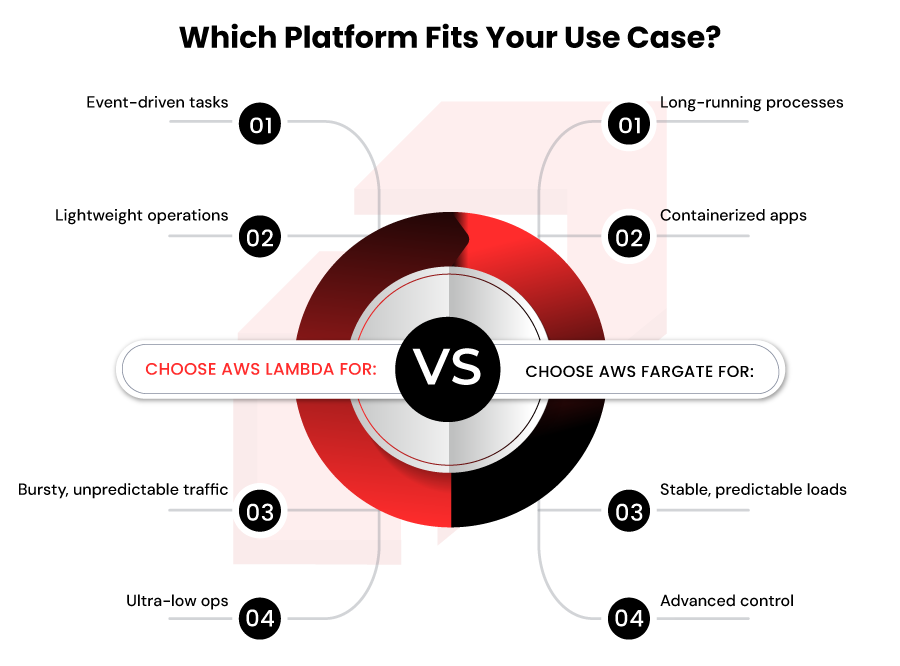
Choose AWS Lambda for:
- Event-driven tasks: Process S3 file uploads, API Gateway requests, or DynamoDB changes in seconds.
- Lightweight operations: Simple ETL snippets, data validation, or automation scripts under 15 minutes.
- Bursty, unpredictable traffic: Scales instantly to thousands of invocations with zero idle costs.
- Ultra-low ops: No servers to manage – ideal for startups or sporadic workloads.
Choose AWS Fargate for:
- Long-running processes: Batch jobs, streaming analytics, or services lasting hours/days.
- Containerized apps: Docker-based microservices integrated with ECS/EKS.
- Stable, predictable loads: Consistent performance for web apps or ML inference servers.
- Advanced control: Custom runtimes, OS tweaks, or legacy monolith migrations.
Important Note: Lambda powers quick, sporadic events. Fargate handles steady, container-heavy workloads.
Hybrid Architecture: Best of Both
Combine them for efficiency – Lambda for fast triggers, Fargate for heavy lifting:
- Pattern: Event (e.g., S3 upload) → Lambda (validate/transform in <1s) → SNS → Fargate (deep processing).
- Real-world examples:
- E-commerce: Lambda validates orders → Fargate runs inventory/fulfilment.
- Netflix: Lambda routes streams → Fargate processes video encoding.
- Airbnb: Lambda handles webhooks → Fargate manages batch analytics.
This approach cuts costs 40-60% while scaling seamlessly.
Additional Factors to Consider When Choosing Serverless Platforms
Development & Deployment Complexity: Lambda requires minimal setup; Fargate demands Docker expertise and orchestration knowledge.
Team Expertise: Do you have container/Docker expertise? If yes, Fargate. If no, Lambda is simpler.
Vendor Lock-In: Both tie you to AWS. Lambda is more proprietary (AWS runtimes only); Fargate uses Docker (more portable).
Latency Requirements: Lambda’s cold start (100-500ms) may breach latency SLAs. Fargate maintains consistent <50ms latency.
State Management: Lambda is stateless (no persistent state). Fargate maintains connections and state. Batch jobs with complex state? Use Fargate.
Conclusion
Both AWS Lambda and Fargate are excellent serverless options – choosing depends on your workload characteristics. Lambda excels at event-driven, bursty, short-duration tasks. Fargate powers continuous, long-running, containerized applications.
Decision Framework:
- Execution < 15 minutes? → Lambda
- Always running or long-running? → Fargate
- Already containerized? → Fargate
- Need event-driven simplicity? → Lambda
- Constant baseline load? → Fargate
- Highly variable traffic? → Lambda
Most mature organizations benefit from both services. Start with Lambda for event-driven workloads; deploy Fargate for everything requiring sustained execution or complex containerization.
Why Rapyder Is the Right Partner for Your Serverless Strategy
The Real Challenge: Most teams default to one service (usually Lambda) when a hybrid approach would save 40% in costs. Having guided 50+ enterprises through serverless migrations, we’ve seen the patterns.
One Example: A financial services client was running overnight batch jobs on Lambda, paying $8K/month in wasted compute. A simple architecture audit identified the jobs were better suited for Fargate – reducing costs to $2K/month while improving performance.
Rapyder’s Serverless Approach:
- Audit current workloads and classify by characteristics
- Recommend optimal service mix (Lambda + Fargate hybrid)
- Cost model your proposed architecture
- Design migration roadmap
- Optimize ongoing costs and performance.
Our Value: As an AWS Consulting Partner, we help organizations avoid costly mistakes. Most enterprises leave 30-50% of potential savings on the table by not optimizing their serverless architecture.
Ready to optimize your serverless infrastructure? A detailed architecture review can identify significant cost savings and performance improvements.