Every year, AWS re:Invent drops announcements that quietly reshape how modern infrastructure is built. This time, one update stands out louder than the others: AWS Graviton5.
If you run cloud workloads that care about performance, efficiency, or cost, this isn’t just another CPU refresh. It’s a shift in how cloud computing is meant to scale in 2026 and beyond.
Let’s break it down – plain, practical, and worth your time.
What Is AWS Graviton?
AWS Graviton is Amazon’s family of custom-built processors designed specifically for the cloud. Unlike traditional CPUs that try to serve laptops, servers, and data centers all at once, Graviton is built for one job: running cloud workloads better.
These processors power a wide range of Amazon EC2 instances and are optimized for:
- Microservices and containers
- Web and application servers
- Databases and analytics
- AI/ML inference and high-throughput workloads
In short, this is cloud-first silicon, not repurposed hardware.
Why Did AWS Create Graviton Processors?
Because the cloud outgrew general-purpose CPUs.
AWS saw three hard truths early:
- Performance tuning at scale matters more than raw clock speed
- Energy efficiency directlyimpacts cloud cost and sustainability
- Tight integration between hardware and cloud services unlocks gains,generic CPUs can’t
By building its own CPUs, AWS controls the full stack – hardware, virtualization, networking, and software optimization. That’s how Graviton consistently delivers better price-performance than traditional x86 options.
AWS Graviton5 Has Arrived
Announced during the latest AWS announcements re:Invent, Graviton5 raises the bar again.
This generation isn’t about marginal gains. It’s about future-proofing modern workloads that are already hitting limits with older CPU architectures.
Think:
- Higher core density
- Faster memory throughput
- Better support for scale-out, cloud-native architectures
If Graviton3 and Graviton4 proved ARM-based cloud CPUs work, Graviton5 proves it is the default choice going forward.
A Quick Look at Graviton Releases
Here’s how the journey stacks up:
- Graviton (Gen 1): Proof of concept
- Graviton2: Real-world adoption, major price-performance leap
- Graviton3: Performance and energy efficiency upgrades
- Graviton4: Memory and compute optimizations for demanding workloads
- Graviton5: Built for next-gen, high-scale, performance-hungry systems
Each release wasn’t just faster – it was more cloud-native.
AWS Graviton Evolution: Version-by-Version Comparison
| Graviton Version | Architecture | Primary Focus | Key Improvements Over Previous Generation | Best-Fit Workloads |
| Graviton (Gen 1) | ARMv8 | Proof of concept | First AWS custom CPU; basic ARM support | Simple web servers, dev/test |
| Graviton2 | ARMv8.2 | Price–performance | ~40% better price-performance vs comparable x86 | Web apps, microservices, containers |
| Graviton3 | ARMv9 | Performance & efficiency | Up to 25% better compute, major energy efficiency gains | Compute-intensive apps, analytics, CI/CD |
| Graviton4 | ARMv9 (enhanced) | Memory-heavy workloads | Faster memory access, improved throughput | Databases, in-memory caching, data processing |
| Graviton5 | ARMv9 (next-gen) | Modern, large-scale workloads | Higher core density, better memory bandwidth, improved performance consistency | High-scale microservices, AI inference, container platforms, always-on workloads |
What This Table Really Tells You
- Every generation isn’t just faster – it’s more cloud-native
- AWS didn’t chase benchmarks; they chased real workload efficiency
- Graviton5 is the first version clearly built for 2025-26-era architectures: containers everywhere, scale-out by default, cost pressure always on
If you’re still running workloads optimized for Gen 2 or Gen 3, this table makes one thing clear:
you’re leaving performance and savings on the table.
How Graviton5 Is Better Than Earlier Versions
Graviton5 isn’t about small tweaks. It’s about addressing how modern applications behave.
Compared to earlier versions, Graviton5 offers:
- Higher compute throughout per core
- Improved memory bandwidth for data-intensive apps
- Better performance consistency under peak loads
- Stronger efficiency for always-on workloads
This directly impacts container-heavy platforms, event-driven systems, and large-scale APIs.
Cost Savings Estimate When Switching to Graviton5 Instances
Switching to Graviton5 instances can unlock ~15–25% lower compute costs compared to equivalent x86 instances – without cutting performance. Built on Arm architecture by Amazon Web Services, Graviton5 is designed to do more work per watt, which quietly compounds savings across always-on workloads.
Where teams really feel the impact:
- Compute-heavy apps (microservices, APIs, batch jobs) see immediate infra cost drops
- Scale-out environments save more as usage grows – no tuning gymnastics required
- Long-running workloads benefit from better price-performance over time
For most production workloads, customers typically recover migration effort quickly, then keep saving every month after.
The real question isn’t “Does it save money?” – it’s “How long do we keep paying extra by not switching?”
Core Features of AWS Graviton5
What makes this CPU Amazon-grade?
- Custom ARM-based architecture tuned for AWS workloads
- High core density for parallel processing
- Optimized cache and memory design
- Lower power consumption per operation
- Native integration with EC2, EKS, Lambda, and managed services
This is not a generic CPU with Amazon badge. It’s purpose-built cloud silicon.
Customer Benefits of Using Graviton 5 (Why This Upgrade Actually Pays Off)
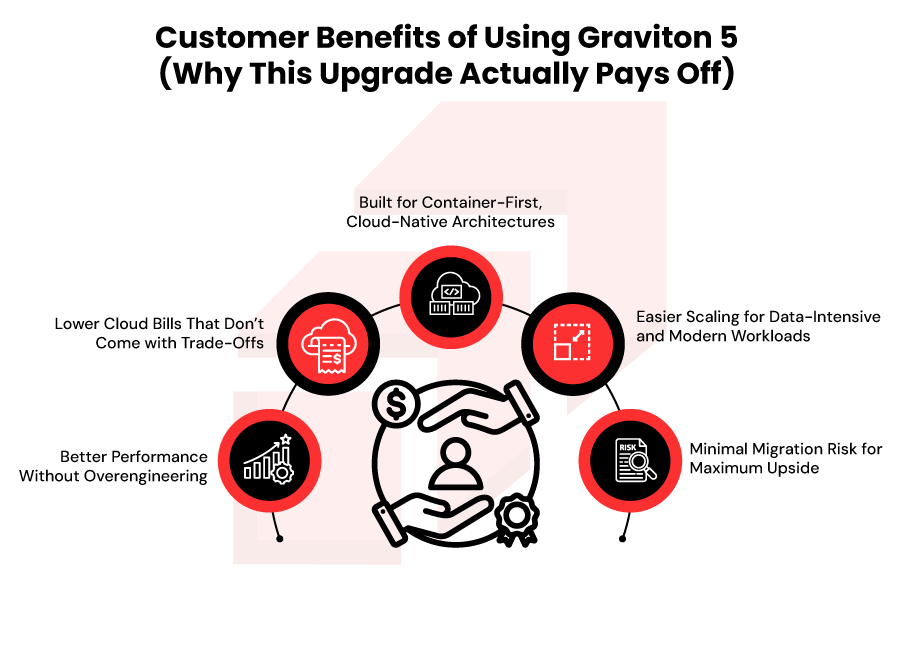
Graviton5 isn’t a “nice-to-have” CPU refresh. It’s one of those rare infrastructure changes where engineering teams feel the difference and finance teams see it on the bill. Here’s what customers really gain when they move workloads to AWS Graviton5.
- Better Performance Without Overengineering
Most teams don’t want more infrastructure – they want more output from what they already run.
Graviton5 delivers higher throughput per core and more consistent performance under load. That means:
- APIs stay responsive during traffic spikes
- Background jobs finish faster without parallel sprawl
- Containers get predictable performance even at scale
Why this matters: You stop compensating for CPU limits with extra nodes, replicas, or workaround architectures.
- Lower Cloud Bills ThatDon’tCome with Trade-Offs
Cost savings often come with hidden trade-offs. Not here.
Graviton5 improves price-performance by design – more work per dollar, not fewer features per instance. Customers typically see:
- Lower EC2 compute costs for the same workload
- Reduced need for overprovisioning
- Better utilization of existing autoscaling policies
Net effect: You save money without slowing down releases or cutting performance corners.
- Built for Container-First, Cloud-Native Architectures
If your platform runs on Kubernetes, EKS, or microservices, Graviton5 feels native – because it is.
It’s optimized for:
- High pod density per node
- Fast container startup and scaling
- Efficient service-to-service communication
Why this matters: You get reliable scale without throwing more infrastructure at the problem- performance stays steady as demand grows.
- More Predictable Performance at Scale
One of the quiet wins of Graviton5 is consistency.
Unlike traditional CPUs that show variance under sustained load, Graviton5 maintains stable performance across:
- Long-running services
- High-concurrency environments
- Always-on production systems
Translation: Fewer performance surprises, fewer midnight alerts, fewer “why is prod slow today?” conversations.
5.Easier Scaling for Data-Intensive and Modern Workloads
Modern workloads aren’t CPU-only anymore. They’re memory-hungry, parallel, and always active.
Graviton5’s improved memory bandwidth and core efficiency make it ideal for:
- High-traffic web platforms
- Streaming and event-driven architectures
- AI inference and real-time processing
Why this matters: Your infrastructure scales with demand – not against it.
- Minimal Migration Risk for Maximum Upside
This is the benefit most teams underestimate.
Graviton5 adoption doesn’t mean rewriting applications from scratch. For many workloads:
- Recompilation or container rebuild is enough
- Managed services already support Graviton
- CI/CD pipelines need minimal changes
Result: High upside, controlled risk – exactly how infrastructure changes should be.
The Bottom Line
AWS Graviton5 isn’t about chasing benchmarks or following trends from AWS re:Invent 2025 announcements. It’s about aligning infrastructure with how modern applications run today.
How Rapyder Helps Customers with Graviton5
Moving to AWS Graviton5 isn’t just a CPU switch – it’s an architectural decision. Done right, it unlocks performance and cost gains. Done carelessly, it creates friction. This is where Rapyder steps in.
Rapyder helps customers at every stage of this journey:
- Workload Readiness Assessment
We evaluate which applications, services, and environments are best suited for Graviton 5 – so you migrate what benefits most, not everything at once.
- Graviton-Optimized Architecture Design
From EC2 and EKS to managed services, we design architectures that fully leverage Graviton5’s performance, memory efficiency, and scale characteristics.
- Low-Risk Migration & Validation
We plan phased migrations, benchmark performance, validate cost savings, and ensure zero surprises in production.
- Performance & Cost Optimization Post-Migration
Migration is just the start. We continuously fine-tune workloads for sustained performance, stability, and long-term cost efficiency.
Ready to Unlock Graviton5 Benefits – Without the Guesswork?
If you’re exploring AWS Graviton5–powered services and want to know:
- which workloads to move first
- how much you can save
- and how fast you can get there
Visit the Rapyder website to start a Graviton5 assessment and get expert guidance tailored to your cloud environment.
Because the smartest migrations aren’t rushed – they’re engineered for impact.
Conclusion
As AWS re:Invent 2025 signals the direction of cloud infrastructure, one thing is clear: custom silicon is no longer optional. It’s foundational.
If your workloads are scaling, costs are rising, or performance ceilings feel too close – this might be the moment to rethink what’s powering your stack.
Would you switch to AWS Graviton5-powered services if it meant better performance at lower cost?
The real question is: why wouldn’t you?