

Last updated: 17 November 2026
An AI chatbot for business should resolve a defined customer or employee task, not merely generate fluent replies. For Dubai organisations, the design must account for English and Arabic journeys, dialects, code-switching, approved knowledge, business-system integrations, privacy, safe escalation and the complete operating cost. Start with one bounded, measurable workflow.
What should an AI chatbot for business actually do?
A production chatbot is a governed service interface. It can answer from approved information, guide a user through a process or perform a controlled action in another system. Those are different levels of complexity and risk, so the design should begin with the intended outcome and authority. For an AI chatbot for business, that authority must be narrow, testable and linked to an accountable owner.
- A rule-based bot follows fixed flows and works well for narrow, predictable choices.
- A grounded generative chatbot uses approved enterprise content to answer more flexible questions.
- A transactional chatbot calls systems to book, update, submit or retrieve information.
Do not begin with “We need a GenAI chatbot.” Begin with the user problem, the current failure rate and the action the bot may safely take. A bot that answers a policy question needs different controls from one that changes a booking or customer record.
High-value AI chatbot for business use cases in Dubai
A strong AI chatbot for business starts with a task that is frequent enough to justify automation, bounded enough to test and supported by reliable information.
Customer support
Answer product, policy, eligibility or troubleshooting questions from an approved knowledge base. Route complaints, ambiguity and sensitive cases to a person with the conversation context attached.
Lead qualification
Collect needs, location, budget band and timeline, then route the lead according to defined rules. The model should not invent product commitments or make uncontrolled eligibility decisions.
Booking and appointment support
Show availability, collect required details, confirm the user’s choice and call a narrow booking API. Confirmation and idempotency controls help prevent duplicate or unintended transactions.
Order, application or case status
Retrieve status after identity verification. Keep the model separate from the source of truth and avoid exposing another customer’s information through weak access controls.
Employee helpdesk
Support IT, HR, finance or procurement questions using role-appropriate content. Restrict sensitive policies and personal data according to the employee’s identity and permissions.
Knowledge assistance
Help teams find and summarise approved documents with citations. This can reduce search time, but the user still needs to see the underlying source and its date.
The UAE government’s own implementations illustrate a useful pattern. TDRA says U Ask limits answers on participating websites to information available on that site. TDRA also operates an Arabic and English trust-services chatbot for a defined information domain. These examples do not prove suitability for every business, but they show the value of clear knowledge boundaries. For an AI chatbot for business, those boundaries should be explicit before launch.
Which use case should you launch first?
For an AI chatbot for business, choose a high-volume, low-to-moderate-risk workflow with:
- an accountable business owner;
- reliable source content;
- a measurable current baseline;
- a clear definition of task completion;
- an obvious human escalation route; and
- enough usage to evaluate quality and cost.
Avoid making a high-impact decision or an irreversible transaction your first deployment. A narrow knowledge or support workflow usually exposes data, language, integration and operating issues with less risk.
What Arabic support means for an AI chatbot for business
An “Arabic supported” label is not enough for an Arabic AI chatbot for business. Dubai users may communicate in Modern Standard Arabic, Emirati or other Gulf Arabic, dialects from across the region, English-Arabic code-switching or Arabizi written in Latin characters. Spelling, names, numbers and industry terminology also vary.
Recent Arabic-language research reports meaningful performance differences across dialects, including Emirati Arabic. Other evaluations find weaker results in dialectal Arabic than in Modern Standard Arabic for several culturally grounded tasks. Open-ended Arabic evaluation can expose weaknesses that multiple-choice benchmarks miss. This matters because an AI chatbot for business must perform on real conversations, not only benchmark prompts.
Evaluate the complete journey:
- Does the bot understand the user’s dialect and intent?
- Can it preserve names, dates, amounts and reference numbers?
- Does it reply in the requested register and tone?
- Can it handle code-switching without losing meaning?
- Is the right-to-left interface readable across devices?
- Does search retrieve the correct Arabic source content?
- Can the bot escalate in the same language with context intact?
- For voice, does speech recognition work under expected accents and noise?
Cloud documentation can confirm technical locale support, not business quality. For example, Azure Speech documents an ar-AE locale and UAE Arabic voices, while Amazon Transcribe documents Gulf Arabic and Modern Standard Arabic with feature differences. Native-speaker testing remains essential.
How to evaluate an Arabic AI chatbot for business
Build a test set from real, anonymised customer or employee intents. Include ordinary tasks, difficult variations and cases that must be escalated.
Represent:
- Modern Standard Arabic and expected dialects;
- English, Arabic and code-switched conversations;
- Arabizi and common spelling variations;
- local names, locations, products and terminology;
- ambiguous, incomplete and emotional messages;
- malicious prompts and requests for restricted data; and
- voice samples if speech is in scope.
Score task completion, grounded correctness, entity capture, language appropriateness, safe refusal, escalation quality, latency and user preference by segment. Report Arabic performance separately from English. A combined average can hide a poor experience for one group.
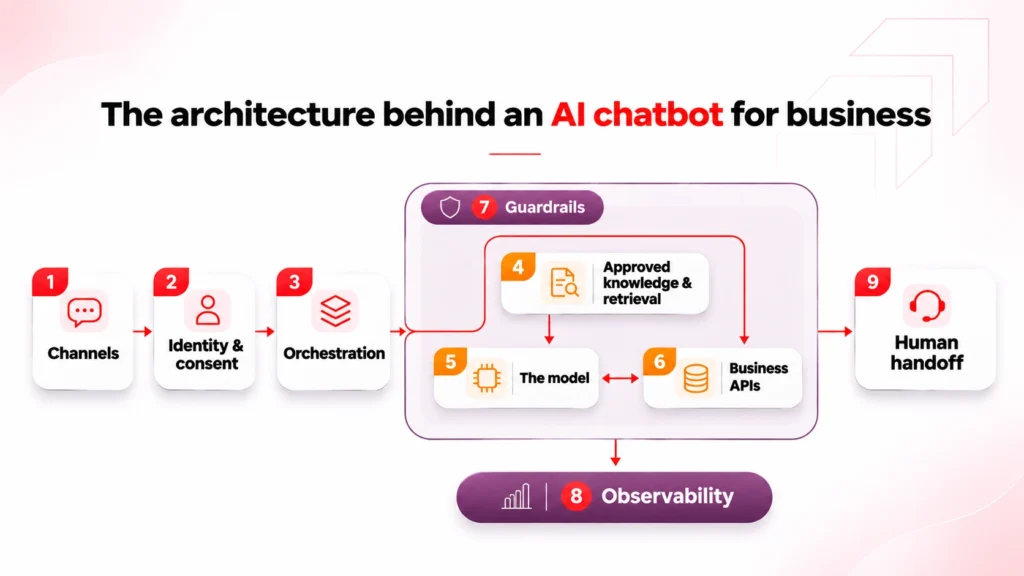
The architecture behind an AI chatbot for business
A reliable chatbot is a system, not a single model endpoint.
- Channels receive messages from the website, app, approved messaging channel or contact centre.
- Identity and consent determine who the user is and what data the workflow may access.
- Orchestration classifies the task, applies policy and decides whether to answer, retrieve, call a tool or escalate.
- Approved knowledge and retrieval provide relevant, permission-aware source content.
- The model generates or structures the response within defined instructions.
- Business APIs expose narrow actions to CRM, ERP, booking or case systems.
- Guardrails filter restricted inputs, outputs and tool actions.
- Observability records quality, safety, latency, cost and incidents.
- Human handoff moves failed, sensitive or high-impact cases to an authorised person.
Retrieval-augmented generation adds content preparation, embeddings, search, reranking, context tokens and latency. Poor retrieval cannot be repaired by asking the model to sound more confident.
What determines AI chatbot cost in Dubai?
There is no defensible generic AED price without a scope. For an AI chatbot for business, a useful estimate models the actual workload, integrations, language requirements and service levels.
Scope and conversation volume
The number of intents, expected conversations, peak concurrency, average turns and response length shape model and infrastructure demand.
Model and context
Model choice, prompt size, retrieved context and output length affect inference cost. A smaller model can be economical for classification or extraction, while a harder task may need a more capable model.
Knowledge and retrieval
Content cleaning, permissions, indexing, embeddings, search, reranking and refresh pipelines add engineering and run costs.
Channels and voice
A web chat differs from an integrated messaging or contact-centre journey. Voice adds speech recognition, synthesis, telephony, latency and accent testing.
Integrations
CRM, ERP, booking, identity and ticketing integrations require API work, validation, permissions, audit logs and failure handling.
Arabic evaluation
Native-speaker design, dialect coverage, test-data creation, terminology review and repeated regression testing are real delivery activities, not optional translation tasks.
Security and data location
Private networking, encryption, redaction, regional deployment, monitoring, penetration testing and sector review affect both architecture and price.
Service levels and operations
Availability, support hours, incident response, content updates, evaluation, model changes and optimisation continue after launch.
Ask vendors for cost per resolved outcome under stated assumptions, plus low, expected and high-volume scenarios. Token price alone is not a business case.
Privacy, security and human escalation
An AI chatbot for business may process personal data across conversations, retrieval and connected systems. The UAE’s data-protection framework establishes rules and obligations for that processing. Compliance depends on the organisation, purpose, data, lawful basis, location, retention, access, contracts and sector requirements.
Practical controls include:
- collect only the data required for the task;
- separate public and authenticated journeys;
- enforce source-level permissions in retrieval;
- redact sensitive content from logs where appropriate;
- restrict every tool to the minimum action and data needed;
- require confirmation or human approval for material actions;
- test prompt injection and data-exfiltration attempts;
- define retention, deletion and incident procedures; and
- make human escalation visible and easy.
The NIST Generative AI Profile treats risk management as an ongoing lifecycle activity. Launch approval is therefore the beginning of monitoring, not the end of governance.
A practical pilot scorecard
Before building an AI chatbot for business, capture the current response time, resolution rate, repeat contacts, cost and user satisfaction for the selected workflow. Then set pilot thresholds for:
- grounded correctness;
- task completion;
- safe escalation and refusal;
- containment or assisted resolution;
- performance by language and dialect;
- latency and availability;
- security test results;
- customer or employee experience; and
- cost per resolved outcome.
Include go, revise and stop conditions. A pilot should be allowed to prove that the use case or architecture is not ready.
How Rapyder can help
Rapyder helps Dubai enterprises turn an AI chatbot for business into measurable business transformation. We begin with the customer or employee journey, then align data readiness, bilingual experience design, cloud architecture, security, business-system integration, human handoff and operating ownership. Our AI chatbot development services are supported by a Dubai presence and multi-cloud delivery capabilities.
Production evidence supports this approach. For Vahak, Rapyder built a multilingual voice-and-text support platform on Amazon Bedrock with grounded retrieval, transactional lookups, automated escalation, human handoff and observability. The case study reports a 50% reduction in support workload and 60% faster response times. In an EdTech student-support implementation, Rapyder used agentic RAG and customer APIs to support actions such as rescheduling, cancelling, pausing and adding classes. That case study reports 30% faster responses, 25% more accurate answers and 40% fewer support escalations.
These examples show what an AI chatbot for business needs beyond fluent replies: governed knowledge, controlled system actions, human handoff, evaluation and operational ownership. For an AI chatbot for business, discovery should finish with one owned journey, an approved knowledge boundary and measurable resolution, escalation and cost targets. Results will vary by use case, data quality and operating environment.
Is your chatbot resolving journeys—or creating more handoffs?
Turn the highest-friction service journey into a bilingual proof of value with clear resolution, escalation and cost targets.
Frequently Asked Questions
No. Cost depends on volume, model and context, channels, voice, RAG, integrations, security, Arabic evaluation, support and service levels. For an AI chatbot for business, request a workload-based estimate under documented assumptions.
Yes. An AI chatbot for business can understand some UAE or Gulf Arabic, but a capability label does not prove quality. Test real Emirati intents, names, numbers, code-switching and escalation cases with native speakers.
Yes, when both appear in the intended audience. The final language mix should come from conversation data and customer research, and may also include English, other dialects and code-switching.
Yes. An AI chatbot for business can integrate with CRM, ERP or booking systems when suitable APIs and access controls exist. Use narrow, validated tools with least privilege, confirmations and audit logs.
No. Compliance depends on the specific organisation, data, purpose, processing, location, retention, contracts and sector rules. Obtain qualified legal, privacy and security review for the complete deployment.
No, not as the starting objective. Automate bounded, repetitive work and support agents while keeping a clear human route for complaints, ambiguity, sensitive cases and failed automation.
Yes. Measure an AI chatbot for business separately by language and dialect. Track task success, correctness, escalation and user experience so an overall average does not hide a weak Arabic journey.