
GenAI multimodal question matching on AWS cut response time from 12 seconds to 3 to 4 seconds and improved vector retrieval by 40% for an EdTech platform.

In short
Executive Summary
An Indian education platform needed to match text, exam-sheet images and handwritten questions against a bank of 3.6 lakh questions across Hindi, English and Hinglish. Rapyder built GenAI multimodal question matching on AWS using multilingual embeddings, HNSW vector search and contextual response generation. The business transformation cut response time from 12 seconds to 3 to 4 seconds, accelerated vector retrieval by 40% and made image-based learning support available at scale.
About Customer
The customer is an Indian education platform that prepares learners for competitive government examinations and school courses. It combines educator-led video lessons with mock tests, live tests, quizzes, targeted practice and accessibility features designed to reach students across the country.
Problem Statement
Students were submitting questions as text, exam-sheet images and handwritten notes, but the existing system could not reliably match them against 3.6 lakh questions across Hindi, English and Hinglish. At roughly 3,000 searches a day, slow and inaccurate retrieval limited the speed and usefulness of digital learning support.
Business Challenges
Efficiently matching student questions from exam sheet images and handwritten questions to a large database of 3.6 lakh questions across Hindi, English, and Hinglish was a major bottleneck.
The existing system was overwhelmed by a daily search volume of 3,000 queries, leading to delays and inaccuracies.
Managing a 35-50 GB data volume while ensuring scalability, robustness, and responsiveness required a fundamentally different, automated approach to question recognition and matching.
There was no automated way to recognize and match questions submitted as images or handwritten text against the existing question database.
Solution Implemented
Built a data ingestion pipeline that extracts questions, options, and answers from a MySQL database hosted on EC2, cleans the raw data to remove HTML tags and invalid entries, and saves the structured output to CSV.
Sent preprocessed data to Amazon Bedrock to generate embeddings capturing the semantic meaning of each question, option, and answer, storing the embeddings and original text in a vector database on Amazon RDS PostgreSQL.
Applied HNSW indexing to the vector database for faster retrieval and improved efficiency of query handling.
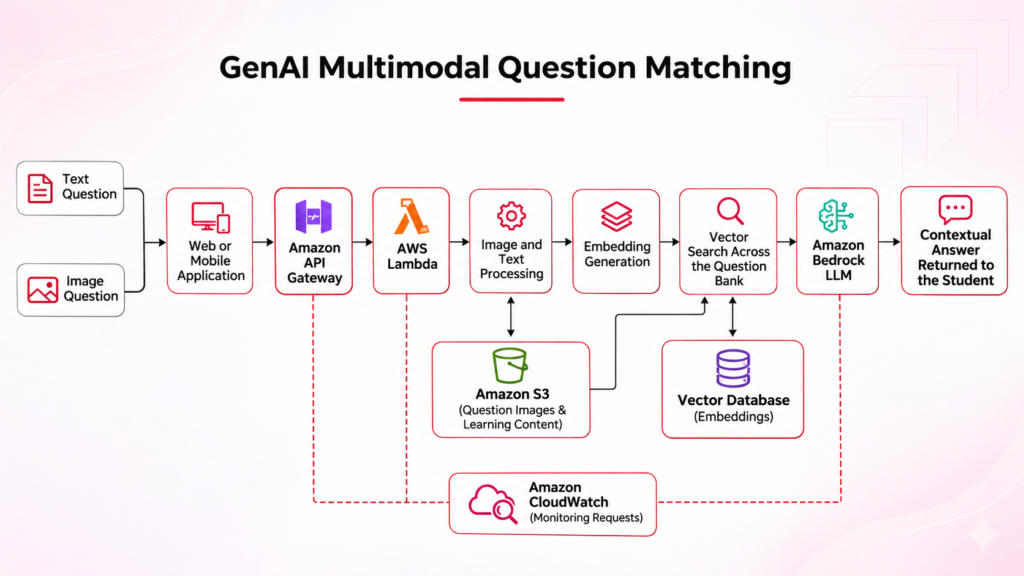
Built a chat pipeline where users submit queries via Amazon API Gateway supporting both text and image inputs.
Used an AWS Lambda function to process the input, converting it into embeddings, extracting text from image inputs via Amazon Bedrock’s Claude 3 Sonnet model, and fetching relevant context from the vector database.
Passed the retrieved context to the Bedrock Claude 3 Sonnet model to generate a response based on the user’s query, delivered back through Amazon API Gateway.
Implemented session management in a MySQL database to maintain user context and enable personalized, natural conversations based on user history.
Used the Cohere embed multilingual model for embedding generation to support Hindi, English, and Hinglish queries.
Technology Stack
- Amazon S3
- Amazon Bedrock
- Amazon API Gateway
- Amazon EC2
- Amazon VPC
- AWS Lambda
- Amazon RDS PostgreSQL
Business Benefits
- Improved user experience through seamless multimodal queries – Students can submit both text and image-based questions, leading to better engagement.
- Fast and accurate responses – Optimized embedding generation via the Cohere embed multilingual model and response generation via Claude 3 Sonnet deliver precise, relevant answers.
- Reduced operational overhead – A serverless architecture scales effectively with demand while minimizing infrastructure costs.
- Response time cut from 12 seconds to 3-4 seconds – Faster interactions lead to higher user satisfaction.
- 40% reduction in vector database retrieval times – Enhanced database query performance through HNSW indexing.
- 30% faster text extraction from image inputs – Quicker responses to user queries submitted as images.
- Real-time response generation – Enhances decision-making and satisfaction with quick, relevant answers.
Key Takeaways
Ready to turn every student question into faster, contextual learning support?
about transforming question discovery with multilingual, multimodal GenAI on AWS.
Frequently Asked Questions
Matching student questions submitted as exam sheet images or handwritten text against a database of 3.6 lakh questions across Hindi, English, and Hinglish was overwhelming the existing system at a daily volume of 3,000 searches, leading to delays and inaccuracies.
Amazon API Gateway accepts both text and image inputs, and an AWS Lambda function converts the query into embeddings while extracting text from any image using Amazon Bedrock's Claude 3 Sonnet model, before retrieving relevant context from the vector database.
Question data is converted into embeddings via Amazon Bedrock and stored in a vector database on Amazon RDS PostgreSQL, with HNSW indexing applied for fast, accurate retrieval even across hundreds of thousands of questions.
Session management is implemented in a MySQL database to preserve user context across interactions, allowing the chatbot to engage in coherent, personalized conversations based on a student's history.
The Cohere embed multilingual model generates embeddings that capture semantic meaning across all three languages, allowing accurate question matching regardless of the language a student uses.


