
How Rapyder built Fibe's GenAI chatbot for fintech support on Amazon Bedrock with RAG, delivering 2 to 3 second answers and 18% fewer call-centre calls.
In short
Executive Summary
Fibe’s scripted chatbot could not answer questions outside a predefined set or retrieve customer-specific loan details, so users turned to the call centre. Rapyder built a GenAI chatbot for fintech support on Amazon Bedrock, combining RAG over Fibe’s knowledge base with authenticated access to live account data. The business transformation moved loan support from a rigid script to contextual self-service, with typical answers in 2–3 seconds and 18% fewer calls to the call centre.
About Customer
Fibe is a digital lending platform built for young professionals who are often underserved by traditional financial institutions. Having processed more than one million loans, the company simplifies access to credit for mid-income customers across India and uses technology to make borrowing faster and easier to navigate.
Problem Statement
Fibe’s existing chatbot followed a fixed dialogue tree. It could not answer questions beyond its predefined script or retrieve account-specific details such as payment and due dates. Customers therefore turned to the call centre, increasing support volume and operating costs while limiting the quality of digital self-service.
Business Challenges
Script-bound answers: The existing dialogue-driven chatbot could answer only predefined questions, leaving anything outside the script unresolved.
Call-centre spillover: Users with questions outside the predefined set had to contact the call centre, increasing support volume.
Rising support costs: Higher call-centre volume increased operating costs directly.
No account context: The chatbot could not retrieve customer-specific information such as payment dates and due dates.
Limited self-service: Fibe needed a contextual, free-flowing conversation rather than a rigid decision tree.
Solution Implemented
Centralised knowledge: Built a knowledge-management system covering FAQ sheets, APIs and other business documents for streamlined access and updates.
Faster model response: Began with an LLM on Amazon Bedrock and moved to a faster LLM to improve response times.
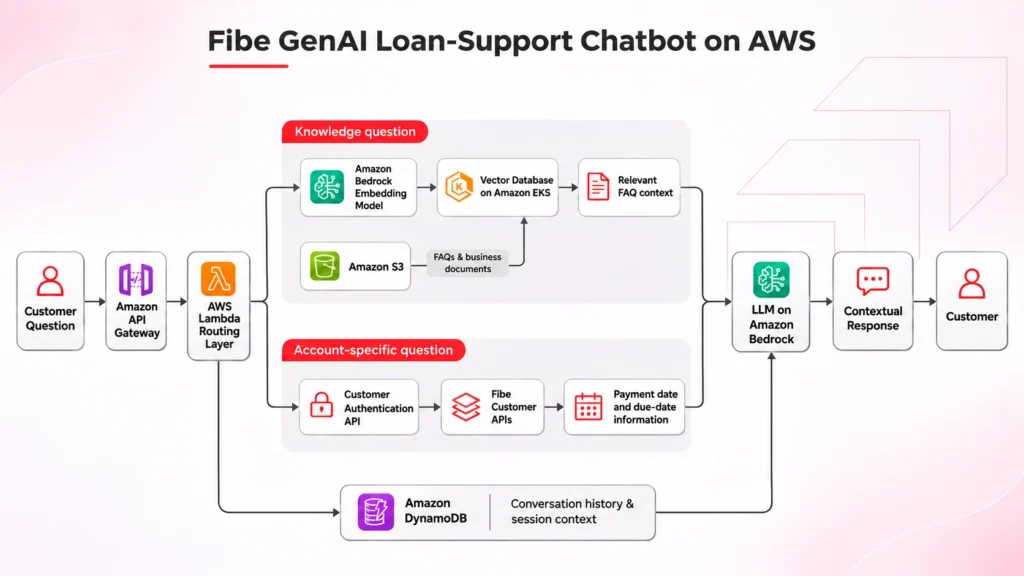
FAQ embeddings: Used an Amazon Bedrock embedding model to embed the FAQ sheet and give the chatbot contextual understanding.
RAG retrieval: Integrated Retrieval-Augmented Generation to retrieve relevant information dynamically and keep answers current.
Session continuity: Stored session data in Amazon DynamoDB to preserve context across a conversation.
User authentication: Authenticated guest users and registered customers through separate backend API flows using CustomerID.
Continuous knowledge updates: Built a pipeline that manages FAQs in a vector database on Amazon EKS without disrupting chatbot functionality.
Live account data: Built a second pipeline that calls customer APIs to retrieve details such as payment dates and due dates.
Prompt refinement: Tuned model parameters and used XML tags and placeholders to improve response accuracy and relevance.
Intent-based routing: Added custom logic to decide whether a question should use FAQ content or a live customer API.
Administrator controls: Exposed Top P, token length and temperature controls through API headers for tailored responses.
Technology Stack
- Amazon S3
- Amazon Bedrock
- Amazon API Gateway
- AWS Lambda
- Amazon DynamoDB
- Amazon EKS
- Amazon VPC
- Amazon EC2
- Amazon ECR
Business Benefits
- 2 to 3 second response times – Contextual answers are typically generated in 2 to 3 seconds, reducing customer wait time.
- 18% fewer calls to the call centre – Accurate, context-aware answers reduced calls to the call centre by 18%, lowering support demand and operating cost.
- Easier knowledge base maintenance – A continuously updateable pipeline reduced knowledge-management effort without disrupting chatbot functionality.
Key Takeaways
Ready to transform repetitive loan support into fast, contextual self-service?
about moving loan support from scripted answers to GenAI self-service, built by our [AI chatbot development](https://www.rapyder.com/solutions/ai-chatbot-development-services/) and [generative AI in f
Frequently Asked Questions
Custom routing logic first classifies the request. It answers knowledge questions from the RAG-based FAQ content and sends account-specific requests to a live customer API. This keeps each response path aligned with the information the customer actually needs.
Yes. The GenAI chatbot authenticates guest users and registered customers through separate backend flows. For registered customers, it can retrieve account-specific details such as payment dates and due dates through backend APIs.
The chatbot typically responds in 2 to 3 seconds. Fibe moved to a faster LLM on Amazon Bedrock to improve response time while keeping answers grounded in its knowledge base.
A dedicated pipeline updates FAQs in a vector database deployed on Amazon EKS. This allows Fibe to refresh its knowledge continuously without interrupting chatbot functionality or rebuilding the customer-support experience.
The implementation reduced calls to Fibe's call centre by 18%. It also created a faster self-service experience, with typical responses in 2 to 3 seconds, while making the underlying knowledge base easier to maintain.


