
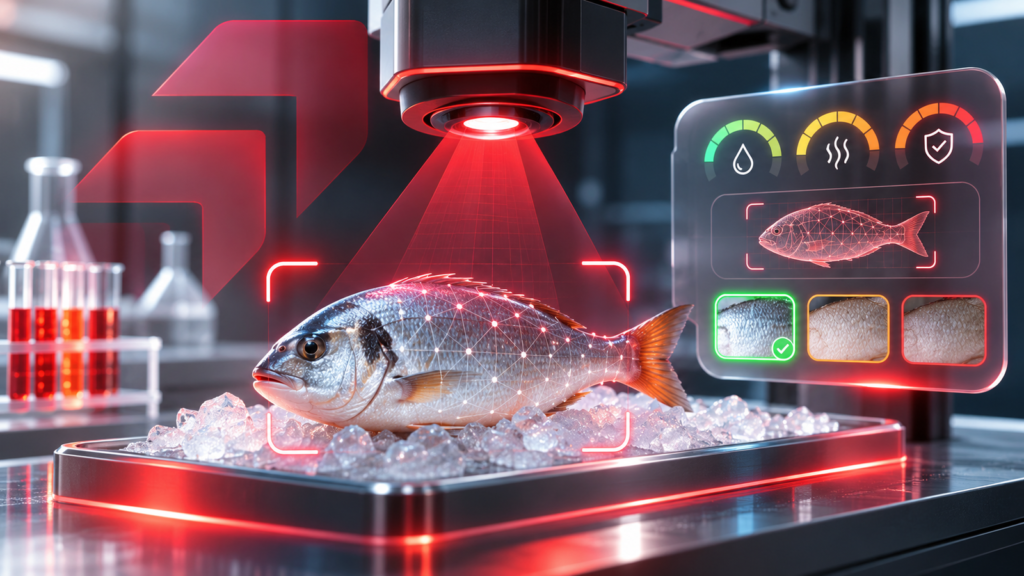
AI freshness classification on AWS helped Tralexho improve fish inspection consistency by 50–60%, speed up assessments by 60–70% and cut rework by 25–35%.
In short
Executive Summary
Tralexho’s Aqualens platform needed a consistent, auditable way to assess fish freshness at processing-plant intake. Rapyder built an AI freshness classification workflow on AWS that validates image quality, extracts freshness signals with an Amazon Bedrock vision model and sends structured features to a CatBoost classifier on Amazon SageMaker. The business transformation improved inspection consistency by 50–60%, accelerated assessments by 60–70% and reduced rework by 25–35%.
About Customer
Tralexho is a Traceability-as-a-Service company bringing greater transparency and trust to food supply chains, with a strong focus on seafood and aquaculture. Its Aqualens initiative digitises intake checks and quality verification in fish-processing plants, connecting freshness assessments with immutable records, QR-based traceability and AI analytics for customers and regulators.
Problem Statement
Fish freshness at intake depended on manual visual checks of eyes and gills. Results varied between inspectors, did not create an auditable record and could not scale without additional trained staff. Tralexho needed a consistent assessment process that could handle changing lighting, cameras and plant conditions while connecting each result to the product traceability record.
Business Challenges
Subjective inspection: Freshness depended on manual visual checks of fish eyes and gills, so judgements varied between inspectors.
Hard-to-defend quality claims: Inconsistent grading made freshness decisions difficult to support with customers or regulators.
No auditable evidence: Manual checks left no structured assessment record tied to a specific lot.
Limited scalability: Inspection volume could not grow without adding trained inspectors.
Variable plant conditions: Any automated method had to tolerate differences in lighting, cameras and product handling.
Broken traceability chain: Freshness results were not linked to end-to-end traceability records.
Solution Implemented
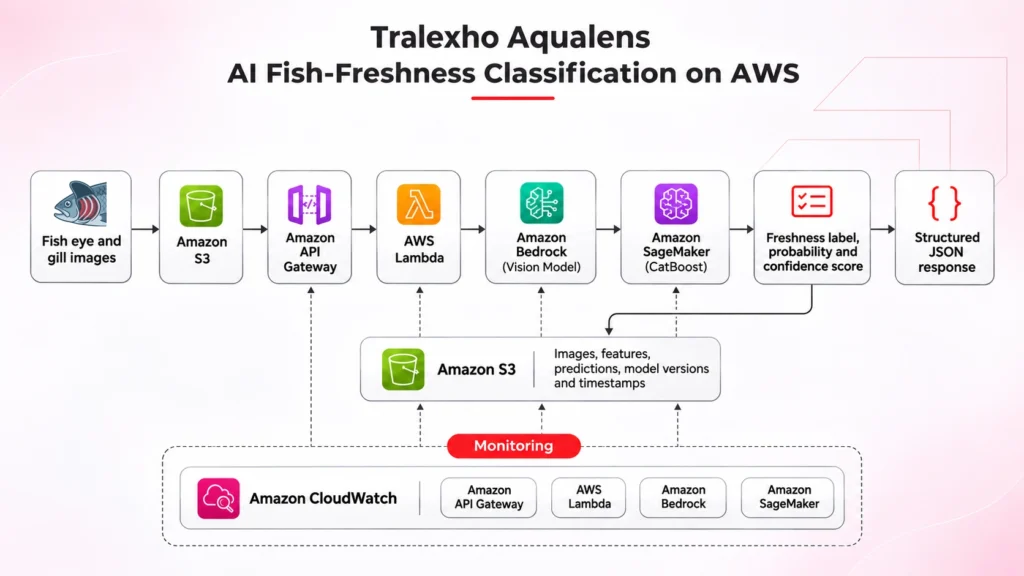
Standardised image capture: Plant operators captured images of fish eyes and gills and uploaded them to Amazon S3 with references to the Aqualens platform.
API-led orchestration: Amazon API Gateway invoked AWS Lambda to coordinate the assessment workflow from image submission to response.
Input validation: AWS Lambda retrieved each image from Amazon S3 and checked its basic properties before analysis.
Image-quality screening: An Amazon Bedrock vision model evaluated focus, framing and lighting before rejecting unusable captures.
Freshness feature extraction: The vision model extracted eye clarity, gill colour, slime, skin condition and rigidity proxies using rules agreed with Tralexho quality experts.
Structured feature vector: The extracted signals were assembled into the tabular schema used during classifier training.
Real-time classification: An Amazon SageMaker endpoint hosted the trained classifier, moving from XGBoost to CatBoost for better handling of categorical signals.
Confidence-aware output: The classifier returned a freshness label with probabilities and confidence indicators.
Auditable response: Image-quality results, feature values, predictions, model version and timestamps were returned as JSON and stored in Amazon S3.
Operational visibility: Amazon CloudWatch captured logs and metrics across AWS Lambda, API Gateway, Amazon Bedrock and Amazon SageMaker.
Technology Stack
- Amazon S3
- Amazon SageMaker
- Amazon Bedrock
- AWS Lambda
- Amazon API Gateway
- Amazon CloudWatch
Business Benefits
- 50–60% better inspection consistency – Objective assessment of eyes and gills produced more uniform quality judgements across operations.
- 25–35% less rework – Stronger generalisation across images of the same species reduced frequent retraining and manual correction.
- 60–70% faster processing – Automated classification returned fresh or non-fresh results within seconds, supporting decisions at intake.
- 40–50% more consistency across conditions – The workflow maintained more consistent performance across changing lighting, camera setups and processing environments.
- Auditable freshness records – Each assessment stored the image, extracted features, prediction, model version and timestamp for traceability.
Key Takeaways
Ready to transform subjective freshness checks into faster, consistent and traceable quality decisions?
Build AI-powered visual inspection that improves consistency, speeds up assessments and creates an auditable quality record.
Frequently Asked Questions
The system analyses standardised images of fish eyes and gills. An Amazon Bedrock vision model extracts signals including eye clarity, gill colour, slime, skin condition and rigidity proxies before the classifier produces a freshness result.
The image is rejected before classification. The Amazon Bedrock vision model first checks focus, framing and lighting, preventing an unsuitable capture from producing a misleading freshness result.
The system returns a freshness assessment within a few seconds. This gives plant operators a decision during intake rather than after the fish has already moved through the process.
No hard accuracy SLA was set because the early-stage dataset contained limited labelled examples for some species. Acceptance relied on testing by expert users, while continued data collection created a path for ongoing improvement.
The workflow improved inspection consistency by 50–60%, accelerated freshness assessments by 60–70% and reduced rework by 25–35%. It also created an auditable record containing the image, extracted signals, prediction, model version and timestamp.


